Is Your World Flying Upside Down?
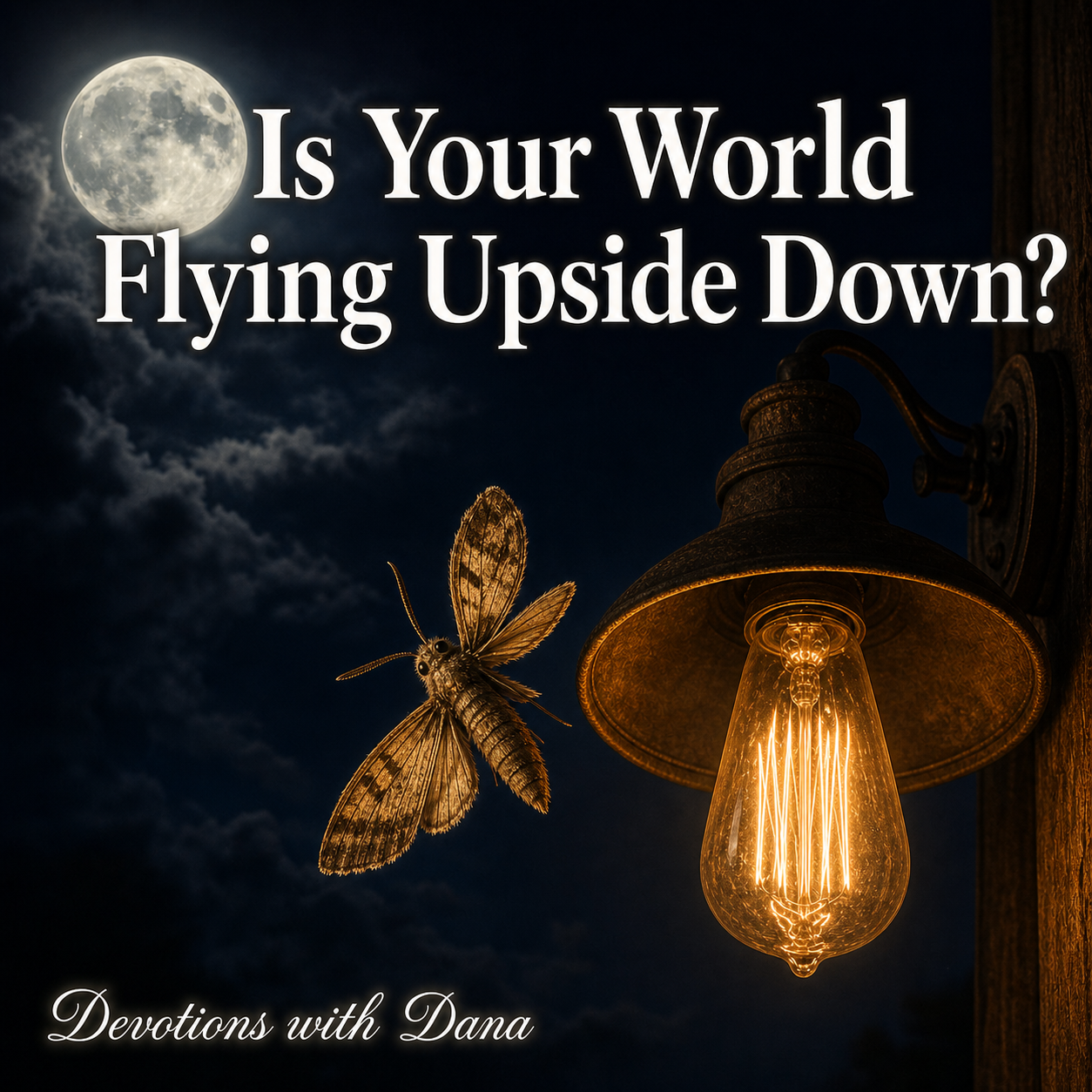
I learned something recently in my Animals of the Bible study that completely rearranged my brain.
It turns out, moths aren't actually attracted to light at all. I know. I know! Everything we thought we knew about moths is a lie. Well, not a lie exactly, but definitely not the whole story.
Here's what's really going on. Because moths fly in complete darkness, they face a very real problem: how do you know which way is up when you can't see anything? God, being the brilliant Designer He is, solved this problem by giving moths a built-in reflex to always keep their backs toward the brightest light. For thousands of years, that worked perfectly. The sky, lit by the sun or the moon, was always the brightest thing around. Back to the sky, fly straight. Simple. Elegant. Genius.
Then we humans had to invent electricity and artificial light.
Now, when a moth flutters near the porch light at your back door on a warm evening, its ancient internal compass lights up and says, "That bright thing is the sky! Point your back toward it!" But because the bulb is close, pointing toward it causes the poor creature to tilt sideways. It tries to correct. It tilts more. It tries again. And before long, it's trapped in a dizzying, exhausting orbit around the bulb, sometimes flipping completely upside down, not because it's foolish or because it wants to, but because its world has been turned upside down by the wrong light.
It is desperately trying to stay oriented. It's just oriented to the wrong thing.
Now, if that doesn't stop you mid-scroll and make you look inward, I don't know what will.
God designed us, like the moth, with a built-in need to orient ourselves toward the Light. Jesus said it plainly in John 8:12: "I am the light of the world: he that followeth me shall not walk in darkness, but shall have the light of life." When we keep our eyes on Him (His Word, His character, His truth), we navigate even the darkest nights. Life makes sense…even when it doesn’t. Our footing is sure even when life is slippery.
But oh, how quickly we let other things become our "sky."
The applause of people who notice how hard we're working? That can become a light we orient toward. The feeling of being indispensable, the one everyone needs, the one who never says no? Light. The pressure of a stuffed calendar, a ministry that's always doing, social media numbers that tell us we matter? Lights, lights, lights.
And not one of them is the sky.
Here's what happens when we orient toward those artificial lights: we start tilting. We feel a little off-balance, so we work harder, say yes to more, and perform a little louder. We tilt further. We try to correct. We tilt again. And before long, we're spinning in an exhausting, dizzying orbit around something that looks like purpose but is slowly burning us out. And sadly, we can't even figure out what went wrong because, after all, aren't we doing good things?
The moth isn't sinning. It's just using a good reflex on the wrong target. And that, my friend, is a very accurate picture of how we can get spiritually upended without even meaning to.
Psalm 119:105 tells us, "Thy word is a lamp unto my feet, and a light unto my path."
Notice that. Not a lamp unto everyone else's feet. Not a light unto my neighbor's path or my pastor's path. My feet. My path. God's Word was given to orient me, personally and specifically, in the direction I need to go.
When we're in the Bible daily (really in it, not just scanning it like a text message), we stay level. We know which way is up. We don't panic when it gets dark, and we don't spiral when the winds pick up.
But when we let the noise of everyone else's opinions, everyone else's urgency, and everyone else's definitions of success become our compass? We'll spend a whole lot of energy going in frantic circles and wonder why we're so tired.
Here's my challenge to you: look at what you're orienting your life toward. Not what you say you're orienting toward. What's actually pulling your attention? What's actually setting your course?
Re-orient. Get back under the true Light. Fly straight.
🔍 PULLING BACK THE CURTAIN: A Peek at the Study Behind This Post
Did you know that the phrase "drawn to the light like a moth to a flame" is actually based on a scientific misconception? That one little crack in conventional wisdom opened the door to this entire devotion.
Here's how the study unfolded:
The initial discovery. The starting point was a straightforward Animals of the Bible research session that led to a surprising tangent: entomologists have known for decades that moth behavior around lights is not attraction but disorientation. A quick search of terms like "moth light attraction myth" and "transverse orientation insects" surfaced the mechanism — their dorsal light reflex, designed to keep them level in natural darkness.
Asking "what did God design this for?" Rather than treating the biology as just a fun fact, the next step was asking the designer's question: why would God build this reflex? Cross-referencing Job 38–39 (where God quizzes Job on the design of creation) reinforced the idea that every animal reflex is intentional. The moth's compass wasn't a flaw. It was genius, just misunderstood by mankind.
Finding the spiritual parallel. The phrase "artificial light turns their world upside down" sparked a word study on the concept of orientation in Scripture. A concordance search on "light" in the KJV (Strong's H216 'owr and G5457 phōs) revealed how consistently the Bible uses light as a metaphor for truth, guidance, and the person of Christ, not just as a feel-good image but as a navigational reality. John 8:12 emerged as the anchor verse because Jesus describes Himself as the light that enables straight walking.
The rabbit trail that paid off. Searching Psalm 119 for "light" and "path" unearthed verse 105, a verse so familiar it's easy to skim. But reading it in the context of the moth study made the personal, specific nature of it pop: thy word is a lamp unto my feet. Not a floodlight for the crowd. A personal lamp. That specificity became a cornerstone of the application.
Crystallizing the warning. The final piece was naming the "artificial lights" concretely, not leaving it vague. Thinking through common modern traps (approval-seeking, busyness performance, schedule overload) and cross-referencing with Galatians 1:10 ("For do I now persuade men, or God? or do I seek to please men?") helped sharpen the application beyond the generic "don't get distracted" message.
⏱️ Total study time: approximately 2–2.5 hours, including several very satisfying rabbit trails and one moment of sitting very still going, "Oh. This is about ME, isn't it?" You know the feeling.
Want to try this yourself? Pick any animal, insect, or creature that crosses your path this week (even a common housefly) and ask two questions: How did God design this, and why? Then take that design into the concordance and ask, where does Scripture use this as a picture of something spiritual? You might be amazed at what you find. Hand on heart, the Bible is the best treasure hunt there is. Here's your shovel. Go dig!