When You’ve Prayed, Planted, and Still See No Fruit
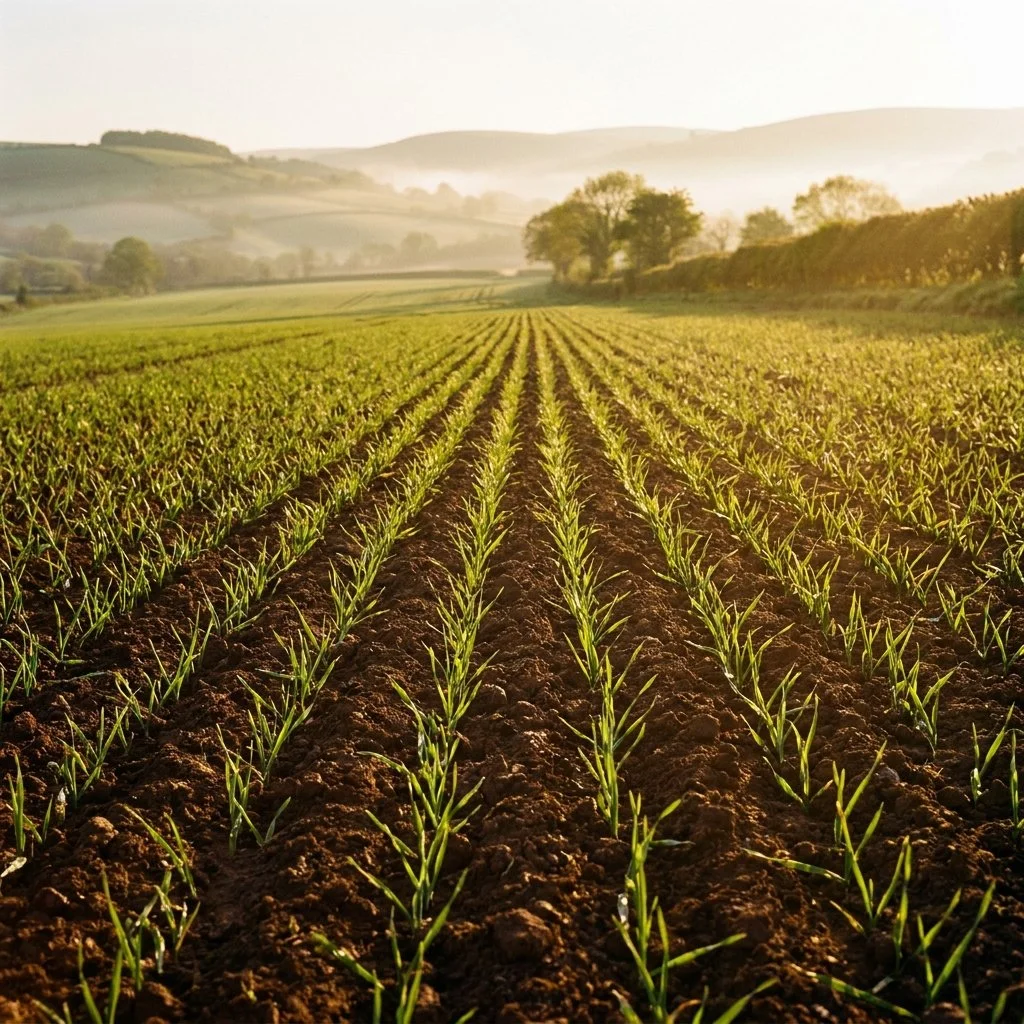
I've become a bit of a field-watcher lately, and I promise it's not as strange as it sounds. As I've mentioned, there's a pasture directly behind our house here in Wales. Over the past several months, I've had a front-row seat to its entire transformation, and let me tell you, it's been quite the show.
It started out gorgeous. Tall grasses waved in the breeze like something out of a storybook, and I'd look out my window and think, Well, isn't that just lovely? It was rhythmic and calming, much like watching ocean waves. Honestly, I could have watched that field sway all day.
Then one morning, I looked out, and the grasses were gone, cut clean down. What had been lush and lovely was now dry, short, and a little sad-looking. I remember thinking, Well, that's depressing!
But the field wasn't finished with its dramatic arc. Next came the manure. Oh, friend, the manure. If you've never smelled a Welsh field being fertilized, count yourself blessed. The whole area (including, unfortunately, our entire house) smelled like something had died and come back specifically to haunt us. We kept the windows shut for over a week, but it did little to repel the odor.
Then the farmer plowed it all under, turning the soil over and over until the field looked like a giant had thrown a temper tantrum in a sandbox: clumpy, uneven, not a single straight line to be found. It was ugly, but fortunately, it smelled better. The stink was disappearing into the dirt.
After that came the combing, where the farmer smoothed everything into neat, soft rows, like the field had finally gotten a proper haircut and a comb-through. Then the turnips went in, and the field looked, well, exactly the same as before planting. Nothing different. No visible change. Just dirt sitting there, doing dirt things.
But now? Now the whole field is covered in a blanket of fresh green shoots, popping up in rows like the earth finally remembered what it was made for. It's bright and full of life.
Every Season Is Doing Something
I couldn't stop thinking about how closely that field mirrors my own life, and probably yours, too. We go through lovely seasons where everything sways gently in the breeze, and life feels like a postcard. Those seasons are wonderful, but if I'm honest, they can also make me a little too comfortable, a little too quick to forget Who's actually in charge of the growing.
Then come the dry, barren seasons. The grass gets cut down. Maybe it's a diagnosis, a financial setback, a friendship that ends, or just the slow grind of chronic pain that never seems to let up. The field of our life looks stripped bare, and we wonder if anything good is left standing. In short, it's depressing.
Then, just when we think it can't get worse, the smelly season arrives. You know, the one where everything feels messy and humiliating, and you'd rather nobody drive past and catch a whiff of what's going on in your life right now. Conflict. Failure. Public struggle. It stinks, plain and simple, and there's no polite way around it.
But here's what struck me about that field: the manure wasn't punishment. It was preparation. What smelled like ruin was actually nutrition, being worked into the soil so that something could eventually grow. Job understood this kind of season better than most of us ever will. In the middle of his unimaginable losses, he said, "But he knoweth the way that I take: when he hath tried me, I shall come forth as gold" (Job 23:10). Job didn't pretend the trial didn't stink. He simply trusted that God knew what He was doing.
Then comes the plowing, resulting in the clumpy, uneven, hard-to-walk season. This is the season where nothing about your life feels smooth. Every step is a little harder than it should be. You're not in crisis anymore, but you're not thriving either. You're just turned over. Being worked. It's uncomfortable, but if that field taught me anything, it's that the turning is what buries the mess into something useful. God isn't leaving us clumpy and uneven out of cruelty. He's working the hard seasons of our lives into the very soil that will one day produce fruit.
And then there's the waiting season, and this one might be the hardest of all. The seeds are planted. The rows are neat. Everything looks exactly like it did before anything happened.
This is the season where we pray and see no answer.
Where we obey and see no result.
Where we plant and see no green.
I don't know about you, but this season tests my patience more than any smelly manure ever could. It's one thing to endure hardship you can see. It's another to wait through a season where absolutely nothing seems to be happening, and you start wondering if the planting even worked.
Galatians 6:9 doesn't waste any words on this exact struggle: "And let us not be weary in well doing: for in due season we shall reap, if we faint not." Notice it doesn't say, "If we don't grow weary." It assumes we will. After all, that's human nature. But the passage tells us not to quit in that weariness. A "due season" is coming, but the key word is due. It arrives on God's timetable, not ours, and definitely not according to how quickly we'd like our turnips (or our prayers) to show results.
And then, finally, the green shoots break through. The blanket of growth appears, seemingly overnight, though we know it wasn't overnight at all. It was the fruit of every single season before it—the loveliness, the cutting, the stink, the turning, the waiting. None of those seasons was wasted. Each one did its job.
If you're standing in a field right now that looks stripped bare, or if the whole neighborhood can smell the mess you're walking through, or if you're stuck in the clumpy, uneven middle where nothing feels stable under your feet, take heart. You are not stuck. You are not forgotten. You are in a season, and seasons, by their very definition, move. God is not wasting a single stage of what you're walking through. He's preparing the soil of your life for a harvest you can't see yet.
So keep your rows straight, friend.
Keep obeying even when the field looks empty.
The green is coming. It always does.
🔍 PULLING BACK THE CURTAIN: A Peek at the Study Behind This Post
This one started with the transformation of the field behind our house, and instead of just complaining about it, I started paying attention to what came next in each step of the field's process.
The observation: Over several weeks, I literally watched the field cycle through six distinct stages—tall grass, cutting, manure, plowing, combing/rows, planting, and finally green shoots. I jotted down each stage as I noticed it out my window, almost like a farming diary.
The "aha" moment: Once the field started sprouting turnip shoots, it hit me that I could count six or seven emotional "seasons" in my life that matched the six or seven farming stages almost perfectly. That's when I knew this had devotional legs.
The Scripture hunt: I decided to bypass the usual "a time for everything" verse from Ecclesiastes 3, since it can often feel overused and even trite if not handled with care. So, instead, I searched my concordance for "reap" and "season" and landed on Galatians 6:9, which fit the waiting stage of the field perfectly and also matched the weariness I felt in my soul.
The rabbit trail: While thinking about the smelly manure stage, I found myself circling back to Job 23:10, which I remembered from a song years ago about trials refining us "as gold." I checked the context in Job 23 to make sure it fit the tone of preparation rather than pure suffering, and it lined up beautifully with the "manure as nourishment, not punishment" idea.
Connecting it all: The final step was matching each farming stage to a specific emotional season (lovely, dry, smelly, clumpy, waiting, growth) and making sure the "waiting" section got the most attention, since that's usually the season readers feel most alone in and least talked about in devotionals.
Total time: This whole study (not counting the weeks watching the field) took me about two days of thinking, and one focused hour of actual writing.
Your Turn: The next time something in your everyday life smells, looks strange, takes way longer than expected, or undergoes some drastic transformation, stop and ask what season it might represent. Grab your Bible, a concordance (or a simple online search of key words like "reap" or "season"), and see what connections start to surface. You might be one bad smell away or tricky trek from your next devotional.