Last week was our Holiday Bible Club, the UK version of Vacation Bible School. I had the privilege of teaching every day, and I spent a week with a few wiggly, wonderful children. Afterward, several adults told me how amazed they were at how well I kept the kids engaged. They also said they had learned something themselves from the lessons. One gentleman summed it up: "It's like your energy and passion were contagious."
He was right. When you teach, especially children, your excitement is catching. If you want your audience excited about what you're saying, you have to be excited about it. Five-year-olds can smell fake enthusiasm from across the building. I taught Kindergarten for nine years, and trust me, they will tell you when you're boring—usually by wandering off to lick something.
Because I was teaching the Bible, my enthusiasm came naturally, and it spilled right over onto my little audience.
Unfortunately, enthusiasm wasn't the only thing spreading that month.
For a couple of months, I'd been dreadfully ill and spent a good bit of time in bed. On top of that, I had a mountain of work piled on top of the regular demands of life. I planned and organized events. I studied and prepared lessons. I shopped for the perfect craft materials, because apparently glitter is a love language. Meanwhile, Jason had his own load of extra work, and the stress flared his diverticulitis and landed him in bed for a few days too.
So we were two tired, achy people running on short fuses in a house that looked like a construction zone. Our schedules were crazy, and our spirits were low and edgy. Naturally, our stress rubbed off on each other. What we didn't see coming was how hard it would hit our little terrier, Tess.
Calling Tess a "velcro dog" is like calling the surface of the sun "a tad warm." She needs her people. She needs attention. And like her momma, she does best when life is smooth and predictable. Sadly, predictable had left the building.
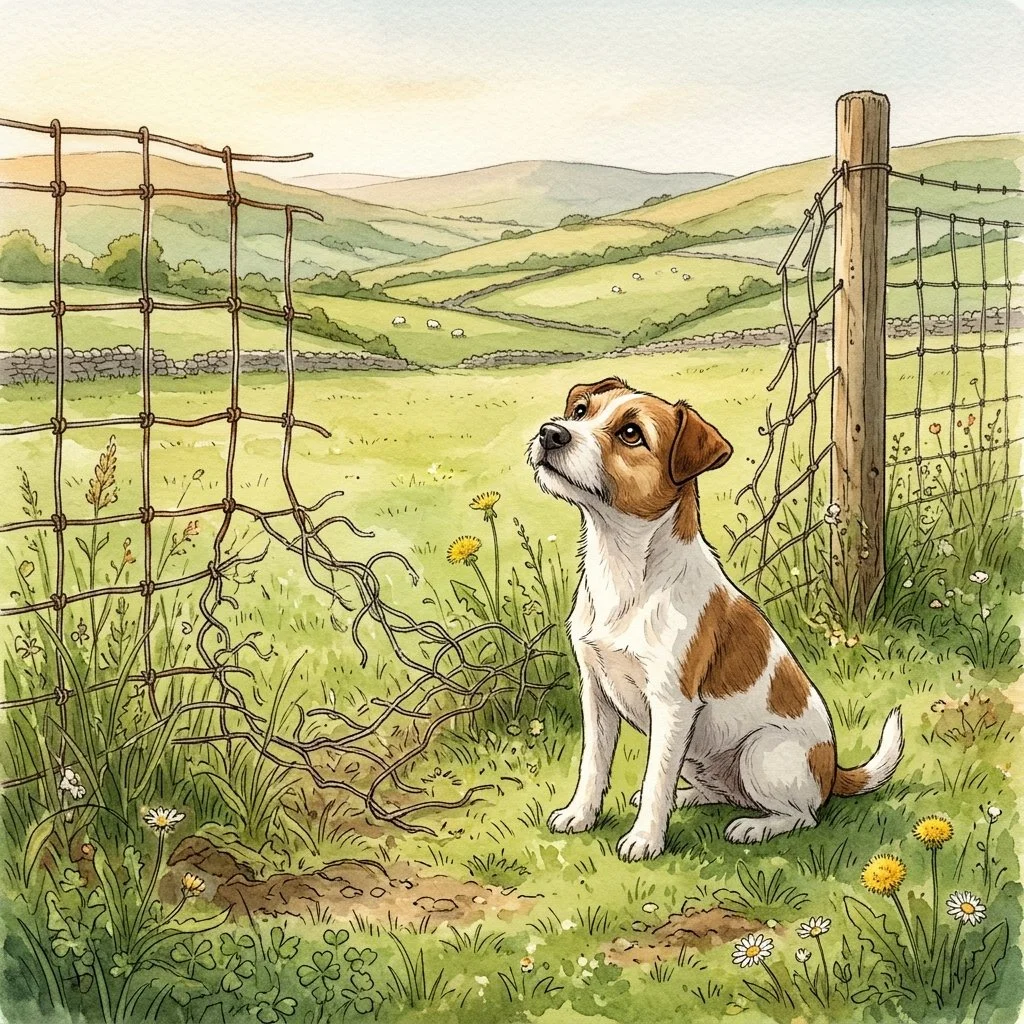
We realized just how deeply she was affected when she escaped the fenced yard and went searching for us while we were at Wednesday night Bible study. So the next time we went out, we locked her inside, where she'd be safe. The little Houdini somehow opened the latched doggie door and escaped through the fence anyway. Rotten critter!
We upped security: Tess in the house, doggie door closed, kitchen door closed, preventing access to the doggie door. By the time we reached the chapel, our phones were ringing. Neighbors were kindly informing us that our dog was touring the neighborhood...again! We still can't explain how she opened the kitchen door and the doggie door. I'm fairly sure she has thumbs now. Either that, or she can walk through doors.
Next, we flipped the doggie door so it opened from the outside, repaired the fence one more time, and shut everything tight. Believe it or not, she escaped again, this time destroying the doggie door entirely. Her anxiety was feeding our stress, and our frustrations were feeding it right back. We laughed when we told people of her escapades, but honestly, we were both about to break.
What we needed was a taste of normal. We needed a routine again, some rest, and a way to remind Tess (and ourselves) that we were safe and loved.
Emotions Are Contagious
Scripture has been saying this for a very long time.
"Make no friendship with an angry man; and with a furious man thou shalt not go: Lest thou learn his ways, and get a snare to thy soul" (Proverbs 22:24-25).
The word "learn" there is the key. We pick up the ways of those we're close to, often without noticing. Anger, anxiety, and irritability can be caught like a cold.
Here's the part I'd never really considered: the people closest to us are the ones most exposed to our moods. Jason and I weren't angry with each other, but we were both depleted. Depleted people leak. Tess caught it all, and she had no way to say, "Excuse me, I'm feeling insecure." She just chewed through the doggie door. And the fence. And anything else that stood in her way.
Who is catching your mood? Your spouse, your children, your coworkers, your dog? I'm not trying to heap guilt on you. Nobody can be sunshine every minute, least of all when sick or overwhelmed. But it does mean our inner state is never just private. Others live downwind of it.
The good news is that the contagion works both ways.
"A merry heart maketh a cheerful countenance: but by sorrow of the heart the spirit is broken" (Proverbs 15:13).
"A merry heart doeth good like a medicine: but a broken spirit drieth the bones" (Proverbs 17:22).
I spent a week at Bible Club passing along joy because I was soaking in the Word. The same Word can reset a weary heart so it spreads peace instead of panic.
Step One: Rest
Jesus modeled this. When His disciples were so busy they couldn't even eat, He said, "Come ye yourselves apart into a desert place, and rest a while: for there were many coming and going, and they had no leisure so much as to eat" (Mark 6:31). He didn't say "push harder." He called them to rest, and not because the work wasn't important. Ministry flows better from a rested soul.
Rest isn't laziness. Sometimes the most spiritual thing you can do is sleep, take a walk, or say no to one more commitment. For the chronically ill among us (hello, friend), rest isn't optional, and God knows it.
Step Two: Restore the Routine
David wrote, "He maketh me to lie down in green pastures: he leadeth me beside the still waters. He restoreth my soul" (Psalm 23:2-3). Notice the order. Green pastures and still waters come before restoration. God builds calm into the day, and when life crumbles that rhythm, rebuilding it is wise stewardship. For us, that meant regular meals, regular bedtimes, regular walks with a certain terrier, and regular, unhurried time in the Word of God.
Step Three: Anchor Your Heart
"In the multitude of my thoughts within me thy comforts delight my soul" (Psalm 94:19). When your thoughts multiply faster than your to-do list, God's comfort delights the soul. And "Now the God of hope fill you with all joy and peace in believing, that ye may abound in hope, through the power of the Holy Ghost" (Romans 15:13). Notice that He fills you so you can abound, which means overflow. You can't pour from an empty cup, but you can pour from an overflowing one.
Step Four: Bear One Another's Burdens
"Bear ye one another's burdens, and so fulfil the law of Christ" (Galatians 6:2). Jason and I eventually admitted we needed help. We told friends, and they prayed, laughed with us, and helped. If you're drowning in stress, tell someone. You were never meant to white-knuckle it alone.
Tess, for the record, is slowly settling as we find our footing again. The fence is patched, the new doggie door has been ordered (and I'm keeping an eye on her thumbs), and the house is looking less like a construction site. Fortunately, Jason and I are beginning to find our groove again, and peace is much easier to come by.
So as you go about your week, take a moment to pause and ask yourself: what am I passing along to those around me? If you find yourself spilling over with stress or worry, don't be discouraged. Turn to the One who fills us with all joy and peace, and let His gentle, restorative love be what truly catches on.
🔍 PULLING BACK THE CURTAIN: A Peek at the Study Behind This Post
This devotion started with a dog who may or may not have opposable thumbs, and a man's comment that my energy was "contagious." Then I wondered whether the Bible says anything about emotions being catching. (Spoiler: it does!)
Start with the odd observation. The "contagious" comment, plus Tess reacting to our stress, made me ask, "Does Scripture talk about moods spreading?" I typed "learn his ways" and "anger" into an online KJV search and Proverbs 22:24-25 popped right up.
Dig into the key word. I looked up "learn" in Proverbs 22:25 using the Strong's lexicon on Blue Letter Bible. The Hebrew word (ʼālap̱, H502) means to learn or be taught. That confirmed the verse was about absorbing the ways of those close to us.
Follow the rabbit trail. Wondering about the flip side, I searched "merry heart" and landed on Proverbs 15:13 and 17:22. Joy is catching too! Then I wondered, "How do I get a merry heart when I'm exhausted?" That led me to Mark 6:31, where Jesus tells His busy disciples to rest.
Check the cross-references. Reading Mark 6 in context, I noticed Jesus said this while ministry was thriving. Next I followed the references over to Psalm 23:2-3, where green pastures and still waters come before restoration, and I added Psalm 94:19 and Romans 15:13 for anchoring the heart.
Let the story shape the structure. Once I saw rest, routine, anchoring, and community all in the text, the four steps practically wrote themselves. I tied in Galatians 6:2 because we'd needed help from friends too.
⏱️ Time note: About two hours, plus one pause to confirm the dog was still in the house and not attempting another escape.
Now it's your turn! The next time something happens to you (a funny moment, a bad day, a dog stunt), ask, "Does the Bible say anything about this?" Grab a KJV and a free online concordance, search a key word, and follow the trail. Treasure is hiding in there, and all you need is a shovel and some curiosity!