You Can’t Charm a Viper
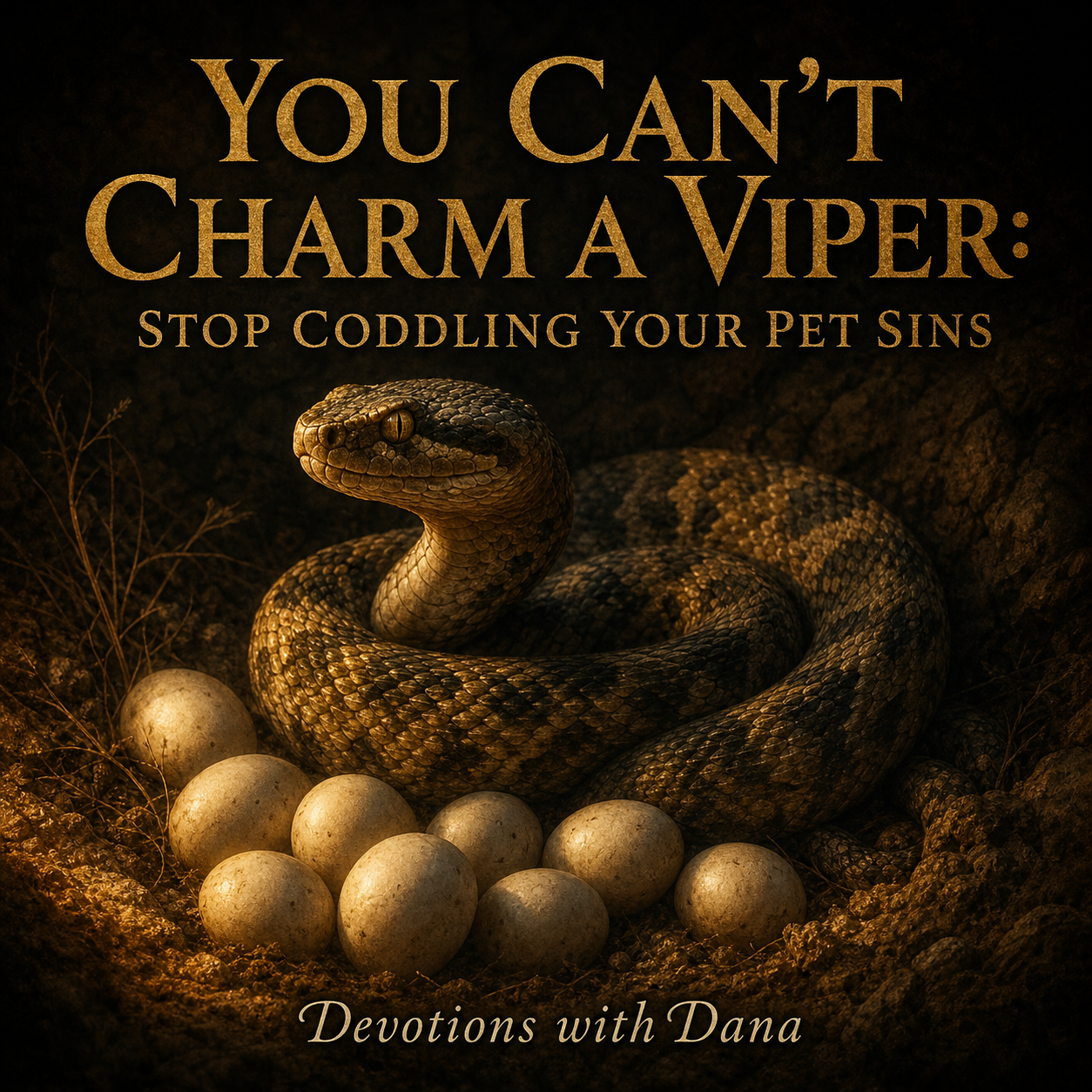
I have a confession to make. I used to think I was pretty good at managing certain little... tendencies. You know the kind. That low-grade resentment I kept on a shelf. The habit I knew wasn't exactly glorifying God but wasn't that bad. The thought pattern I let simmer because, hey, at least I wasn't acting on it. I had it under control.
Or so I thought.
The Bible has a word for it: cockatrice.
Now, before you look at me like I've lost my mind, stay with me. The King James Bible uses this creature to paint one of the most chilling and personally convicting pictures of sin I have ever encountered.
Isaiah 59:5 says, "They hatch cockatrice' eggs, and weave the spider's web: he that eateth of their eggs dieth, and that which is crushed breaketh out into a viper."
The cockatrice of the KJV refers to a highly venomous viper native to the Holy Land. It's the kind of snake that doesn't announce itself or slither dramatically across your path. Instead, it buries itself in the sand or coils motionlessly among the rocks. It is completely invisible right up until the millisecond it strikes. And when it does strike, its hemotoxic venom doesn't just sting. It goes to work immediately, destroying blood cells and tissue from the inside out.
Like most snakes, the cockatrice lays eggs, and those eggs look absolutely harmless. Small, smooth, pale, quiet. Nothing alarming about them at all. But nestled inside each one is a fully formed, venomous killer ready to go the moment it cracks that shell.
In the Scriptures, Isaiah wasn't just drawing a vivid picture for the fun of it. He was describing us, or at least what we tend to do with the sins we decide to keep. We don't always run headlong into catastrophic rebellion. Most of the time, we simply find a warm, dark, quiet corner of our hearts and incubate. We sit on those little eggs of bitterness, pride, jealousy, or compromise and tell ourselves they're harmless. Dormant. Under control.
But here's where Jeremiah 8:17 lands like a thunderclap: "For, behold, I will send serpents, cockatrices, among you, which will not be charmed, and they shall bite you, saith the LORD."
In the ancient Middle East, snake charming was a legitimate skill, but it only worked on cobras, which are highly visual creatures that respond to the swaying of the charmer's instrument. Vipers? Completely different story. Unpredictable, easily agitated, and utterly unimpressed by your performance. No amount of rhythm, music, or careful maneuvering will make a viper cooperate. You simply cannot manage one.
And that, friend, is precisely the point.
We like to think we can charm our pet sins. We negotiate with them. We give them a little room, keep them contained, and check on them regularly to make sure they haven't gotten out of hand. We fashion ourselves as the handler, not the victim. We think we're in charge.
But we are not in charge!
The sinful thought you've been entertaining? It's incubating. The bitter root you've been nursing? It's incubating. The ungodly habit you keep meaning to deal with later? Still incubating. And the moment you think you've got it settled comfortably in its warm corner is exactly when it hatches. It will not be charmed, but it will bite.
David understood this. In Psalm 66:18, he wrote, "If I regard iniquity in my heart, the Lord will not hear me." To "regard" iniquity means to look at it, to keep an eye on it, to let your gaze linger. In other words, to incubate it. The consequences aren't just personal destruction. Unconfessed, coddled sin cuts off the very line of communication with our Father.
The only safe thing to do with a cockatrice egg is to refuse it a warm place to rest. Don't invite it in. Don't set up a little nest for it and promise yourself you'll deal with it tomorrow. Psalm 119:11 says, "Thy word have I hid in mine heart, that I might not sin against thee." The antidote isn't willpower. It's filling that space with something that leaves no room for eggs to incubate.
I know it's easier said than done. Believe me, I know. Those "pet" sins feel familiar. Sometimes they even feel like friends. But a viper in your lap is not a pet. It's a predator waiting for its moment.
🔍 PULLING BACK THE CURTAIN: A Peek at the Study Behind This Post
The spark for this devotion came from one of the most overlooked creatures in the entire KJV Bible — the cockatrice. The moment you realize that word appears four times in the King James Version and almost no modern translation keeps it, you know you're standing at the edge of a rabbit hole worth diving into.
Here's how the study unfolded:
Start with the strange word. The Hebrew behind "cockatrice" is tsiph'oni, a word scholars connect to a specific class of highly venomous vipers native to ancient Canaan. Run a concordance search on "cockatrice" in the KJV and collect your four verses: Isaiah 11:8, Isaiah 14:29, Isaiah 59:5, and Jeremiah 8:17. Read each one in context before doing anything else. Notice immediately that these aren't decorative references; they carry real warning.
Dig into the biology. A quick search into the vipers of the Holy Land (the Levantine viper and Palestine viper are prime candidates) surfaces the four key traits that become the backbone of this devotion: ambush predator behavior, egg-laying reproduction, hemotoxic venom, and their resistance to snake charming. Cross-reference this with what you know about Middle Eastern snake-charming practices (Ecclesiastes 10:11 is a wonderful side reference here) and the contrast in Jeremiah 8:17 becomes electrifying.
Let Isaiah 59:5 do the heavy lifting. The image of hatching eggs is where the devotion crystallizes. Look up the Hebrew verb for "hatch" (bāqa' — to cleave, split open, break through) and you'll feel the violence of the image. This isn't passive. Something is working, splitting, emerging. That's the moment the application snaps into focus: incubation of sin.
Hunt for the "regarding iniquity" connection. With the egg/incubation concept in hand, search cross-references for passages about entertaining sin in the heart rather than fleeing it. Psalm 66:18 is the treasure find here — that word "regard" (Hebrew rā'āh) means to look at, observe, keep your eye on. It's the picture of a person watching over those eggs, keeping them warm. The devotional thread between Isaiah 59:5 and Psalm 66:18 practically writes itself.
Land on the "not be charmed" phrase in Jeremiah 8:17. This is where the devotion gets its title and its sharpest edge. Research snake-charming in the ancient Near East, note the specific references in Psalm 58:4-5 and Ecclesiastes 10:11, and confirm what herpetology confirms: vipers simply don't respond to charming the way cobras do. The theological application — you cannot manage your pet sins any more than you can charm a viper — is the punch that drives the devotion home.
⏱️ Total study time: about 2.5–3 hours, including rabbit trails into Hebrew word studies and a brief detour into ancient snake-charming history that was absolutely worth it.
This is the kind of study that reminds you why Bible words matter, even the weird, archaic, "nobody-uses-that-anymore" ones. The KJV translators preserved something extraordinary in that word cockatrice, and digging it out feels like striking gold. Want to try it yourself? Grab a Strong's Concordance, pick the strangest-sounding word in your next Bible reading, and follow it wherever it leads. You might be surprised what's hiding in plain sight.