Are You Being Managed or Ministered To?
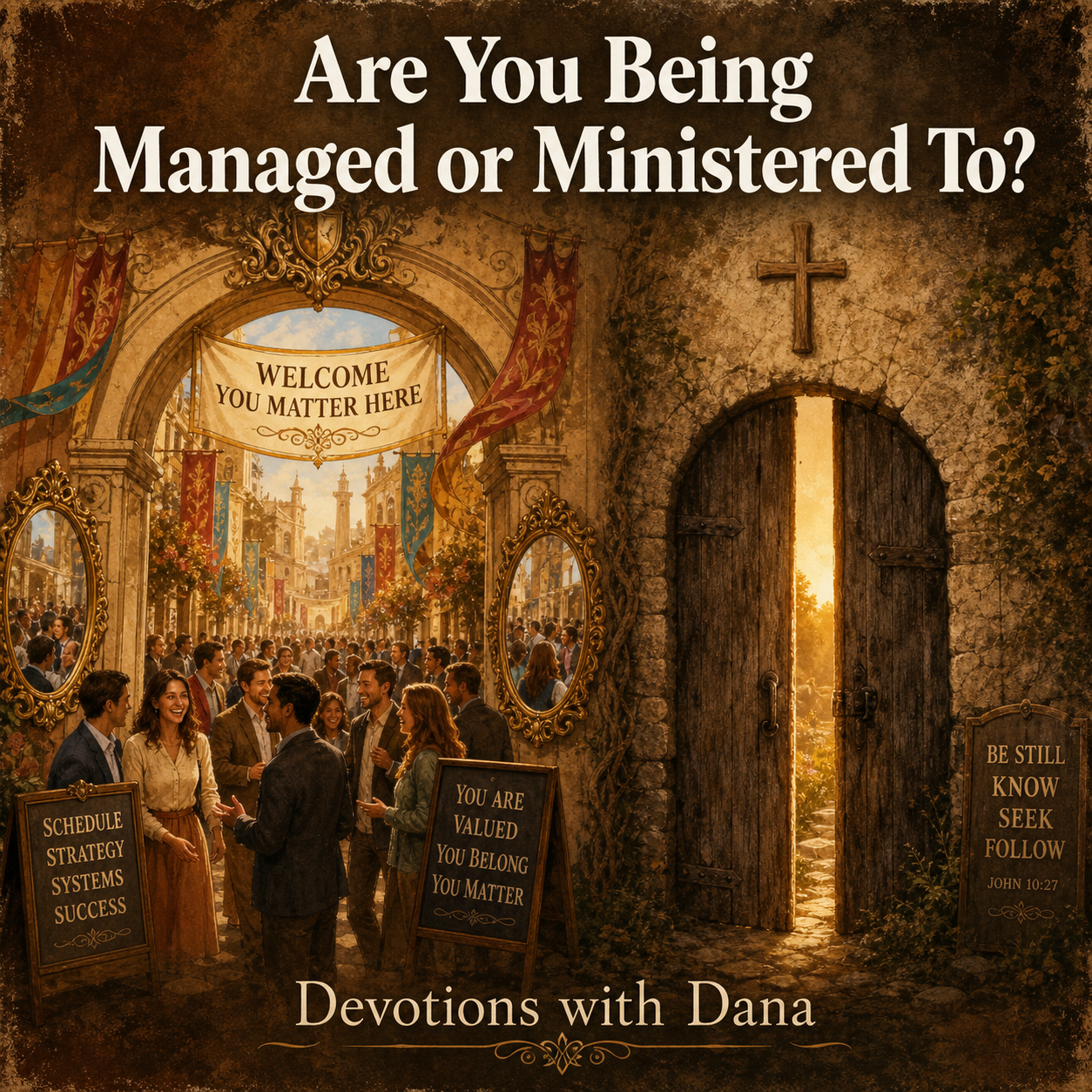
I have a confession to make: I'm a sucker for a good compliment. Tell me my hair looks nice, and I'll follow you to the grocery store. Compliment my writing or teaching, and I might just invite you to move in. Humans have a soft spot for people who make us feel seen, understood, and validated. It's wired into us. And unfortunately, the wrong people know how to exploit that wiring like a seasoned electrician.
Meet Absalom. He was David's son, and if there were an ancient award for "Most Charming Man in the Kingdom," he would have won it three years running. The Bible tells us he was devastatingly handsome, and he knew how to use every inch of that gift. But looks were only half of his toolkit. The other half? Words.
Second Samuel 15 paints a picture that should make every one of us a little uncomfortable. Absalom would rise early in the morning and position himself at the city gate, which was prime real estate for a political agenda. When people came to bring their complaints before the king, Absalom was right there with a warm smile. He'd call them over, listen intently, nod sympathetically, and then deliver the line that sealed the deal every single time:
"See, thy matters are good and right; but there is no man deputed of thee to hear thee." And then he would subtly add, "Oh, that I were made judge in the land!" (2 Samuel 15:3-4).
Translation: You deserve better. I get you. Vote for me.
He never once asked whether their complaints were legitimate. He never weighed the evidence, consulted the law, or sought wisdom. He just agreed with everyone who walked through that gate. The Bible says he did this to "all Israel that came to the king for judgment" (2 Samuel 15:2). Every single person. He was running the world's first feel-good campaign, and it was working brilliantly.
"So Absalom stole the hearts of the men of Israel" (2 Samuel 15:6).
Stole them. Like a pickpocket who leaves you smiling as he walks away with your wallet.
Here's what gets me about this story: the people weren't dumb. These were real men and women with real grievances. They weren't wrong to want justice. But they were so hungry for someone to hear them, so starved for validation, that they handed their loyalty to a man who never once told them anything true, only the things they wanted to hear. And it nearly cost an entire nation everything.
We live in an age of Absaloms. They're everywhere.

In pulpits.
In parliaments.
In podcasts.
In our social media feeds.
The Absalom spirit doesn't show up wearing a red suit with horns and a pointy tail. He shows up with a listening ear, a sympathetic nod, and the uncanny ability to tell you exactly what you were hoping someone would say. He never challenges you. He never corrects you. He never introduces you to a God who is holy and expects something of you. He simply mirrors your desires back at you, gift-wrapped with a shiny bow.
And we eat it up like warm chocolate cake.
Ironically, Jesus told us this was coming. He said:
"Enter ye in at the strait gate: for wide is the gate, and broad is the way, that leadeth to destruction, and many there be which go in thereat: because strait is the gate, and narrow is the way, which leadeth unto life, and few there be that find it" (Matthew 7:13-14).
Notice He didn't say the broad way was scary or obviously dangerous. He said it was wide. Roomy. Comfortable. Easy to walk. Nobody has to duck, squeeze, or sacrifice anything on the broad road. And that's precisely why it's so crowded.
The narrow gate looks like a pastor who preaches the whole counsel of God even when it stings. It looks like a friend who loves you enough to say the hard thing. It looks like a parent who says no when yes would be so much easier. It looks like you and me, choosing to speak truth in love even when the room would much rather hear a nice, agreeable lie.
Faithful living is not the same as popular living. Absalom was popular. He was magnetic, warm, and universally loved right up until the moment he led an entire nation into rebellion against God's anointed king. Popularity is not always a testimony.
The narrow gate is hard. But it leads somewhere. And that " somewhere" makes all the difference.
🔍 PULLING BACK THE CURTAIN: A Peek at the Study Behind This Post
A good chunk of my newest book, Hope Refined, deals with David’s son, Absalom, whose morning routine at the city gate (2 Samuel 15:2-6) is one of those Bible passages that feels shockingly modern, as if it could have been lifted from a campaign-trail news cycle rather than ancient Israel.
Start with the text. The study begins in 2 Samuel 15:1-12. The key observation is the method of Absalom's conspiracy. It was not violence or force, but strategic sympathy. He wasn't overthrowing the king with an army (yet). He was doing it with words and a listening ear. That's the hook.
Mine the Hebrew. The word translated "stole" in verse 6 (ganab, גָּנַב) is the same root as the one used in the eighth commandment: "Thou shalt not steal." This wasn't a casual metaphor. The hearts of Israel were taken from their rightful king just as surely as property taken by a thief. A Hebrew word study (using Strong's Concordance) makes this devastatingly clear.
Chase the cross-reference. From Absalom's wide gate, the trail leads naturally to Matthew 7:13-14 and Jesus' sermon on the two roads. The connection is striking: the wide road isn't labelled as dangerous. It's just roomy. Just like Absalom's method. No resistance. No friction. No demands.
Look for the New Testament echo. A rabbit trail through 2 Timothy 4:3-4 — "they shall heap to themselves teachers, having itching ears" — shows that this pattern was expected to accelerate in the last days. Paul's warning and Absalom's behavior are separated by a thousand years but describe the same human appetite.
Let the application find you. The question isn't just "who are today's Absaloms?" but "am I ever an Absalom?" — telling people what they want to hear rather than what they need to hear. That's where the devotion turns personal.
⏱️ Total study time: about 90 minutes, including a rather satisfying rabbit trail through 2 Samuel's genealogies that had absolutely nothing to do with this devotion but was fascinating, nonetheless.
You don't need a seminary degree to study like this, just a Bible, a Strong's Concordance (or a free online tool like Blue Letter Bible), and a willingness to ask why. Start with one observation that surprises you, pull the thread, and see where it leads. You might be amazed at what God has hidden just beneath the surface. It’s time to dig!

Drawn back in time to the court of Israel's greatest king, Merlin arrives as an adviser on a mission to find the model of kingship he will one day need for Arthur. What he finds instead is a palace where songs are fading, loyalties are fracturing, and the air itself warns that something is about to be lost.
From feasts where wine is a weapon to a forest where the very earth rises up to fight, Merlin witnesses a household undone by what it refuses to name. Walking the razor's edge between friendship and obedience, he must wrestle with the hardest questions a counsellor can face and carry those answers into the future.
What he learns in the shadow of David's throne will follow him into every court he ever enters, every king he ever advises, and every legend he is yet to live.
Hope Refined is a vivid blend of biblical history and Arthurian legend, perfect for readers who love their fantasy grounded in faith, consequence, and hard‑won grace.