Are You Using the Right Tool for the Job?
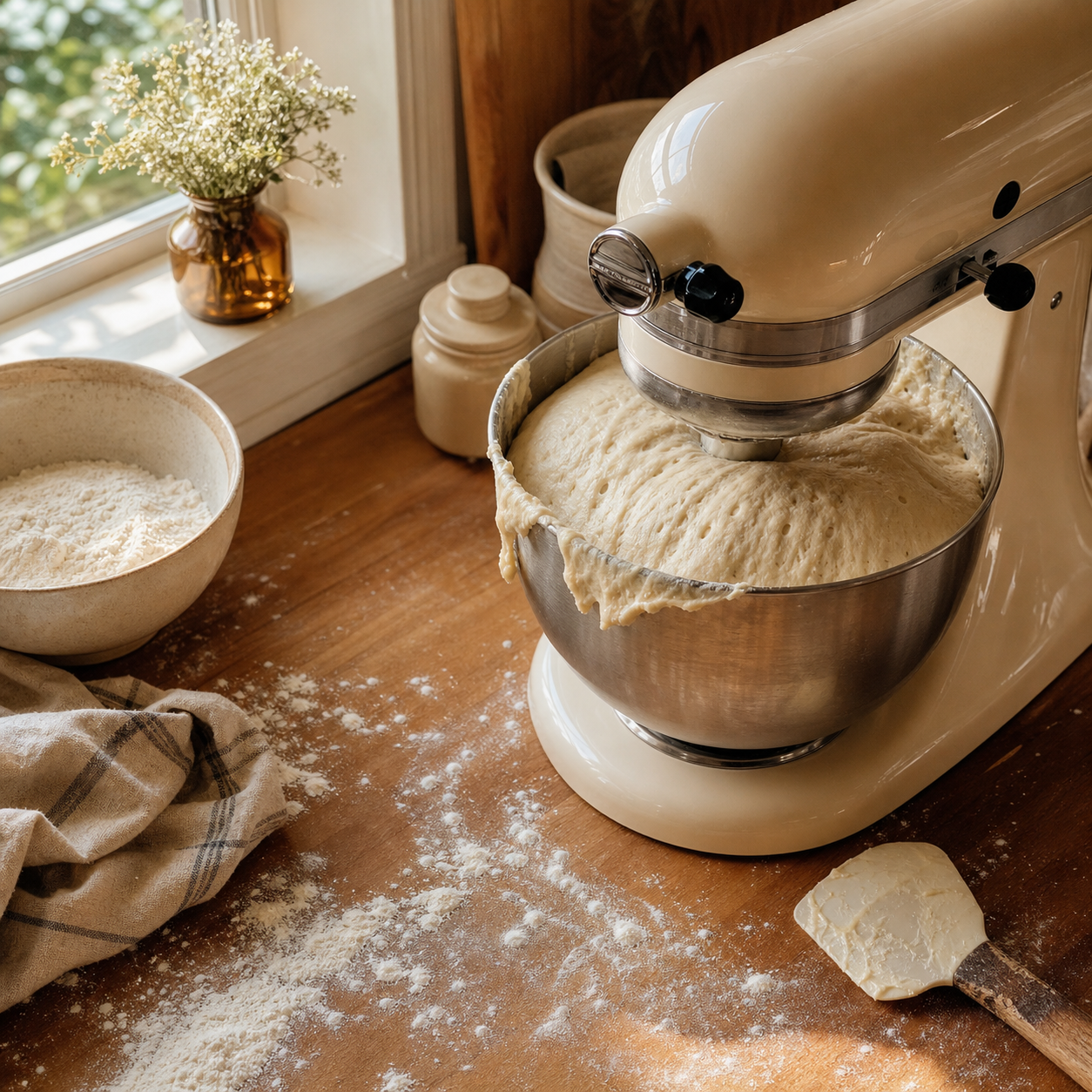
My husband, Jason, loves to bake. Give him some flour (or wheat berries to grind his own), yeast, and a stand mixer, and he's happy as a clam. This week, he decided homemade rolls were on the dinner menu, and everything was going smoothly...until the dough started climbing up the side of the mixing bowl like it was trying to make a great escape.
Now, Jason knows the drill. When dough sticks to the bowl, you grab a rubber spatula and scrape it back into place. Simple. Easy. Effective. But Jason, in a stroke of "genius," decided he didn't want to dirty another dish. (Bless his heart!) He'd already used his handheld dough whisk, so surely that could double as a spatula, right?
Wrong! So very wrong!
What followed was a mechanical collision of epic proportions. The mixer attachment snapped. The dough whisk bent into a shape it was never meant to hold. Two kitchen tools, both mortally wounded, and not a single roll any closer to the oven. Honestly, I still don't know which tool "won" that battle, because both looked like they'd lost...badly!
The thing about using the wrong tool is that it doesn't just fail to fix the problem; it usually creates new ones. And if I'm honest, I do the same thing in my spiritual life more often than I'd like to admit.
When Life Sticks to the Sides
Let's face it, life gets sticky. Stress builds up around the edges of my days as deadlines, disappointments, health scares, and family drama, and I need something to scrape it back into a manageable center. The problem is, I don't always reach for the right tool.
When I'm exhausted, my instinct is to reach for a Netflix binge, an energy drink, or a tub of ice cream instead of rest and prayer. When I'm anxious, I try to "whisk" my way through by controlling every detail myself instead of scraping my worries onto God, who actually invites me to hand them over. When I'm spiritually dry, I try to manufacture growth through sheer willpower and good intentions instead of picking up the one tool actually designed for the job: God's Word.
Hebrews 4:12 says, "For the word of God is quick, and powerful, and sharper than any twoedged sword, piercing even to the dividing asunder of soul and spirit, and of the joints and marrow, and is a discerner of the thoughts and intents of the heart."
Did you catch that? Scripture isn't described as "helpful" or "nice to have." It's called quick, powerful, and sharper than a sword. That's not a butter knife or a dough whisk trying to do a spatula's job. That's the exact tool built for the exact task of cutting through the mess in our hearts and minds.
And yet, how often do I try to fix my heart with a pep talk instead of Scripture? How often do I try to mend a broken relationship with my own cleverness instead of the wisdom James promises is available to "every one that asketh" (James 1:5)? How often do I try to grow my faith by binge-listening to podcasts about faith instead of actually opening my Bible and letting the Author speak for Himself?
The Real Cost of Using the Wrong Tool
What strikes me most about Jason's kitchen catastrophe is that using the wrong tool actually broke something in the process. The mixer attachment wasn't reusable after that. The dough whisk was permanently warped.
Spiritually speaking, that's often exactly what happens when I try to force the wrong solution onto a God-sized problem. When I try to numb my grief instead of grieving it before the Lord, I often deepen the wound with guilt or addiction. When I try to out-argue a friend instead of praying for wisdom to speak gently, I often further damage the relationship. When I try to earn my way into feeling "good enough" for God instead of resting in grace, I pile on shame that wasn't mine to carry in the first place.
Second Corinthians 10:4 reminds us, "For the weapons of our warfare are not carnal, but mighty through God to the pulling down of strong holds." Paul isn't just whistling a lovely tune here. He's being practical. The battles we face against worry, temptation, discouragement, and weak faith cannot be won with carnal, self-made tools. We need weapons "mighty through God," which means prayer instead of panic, Scripture instead of self-help, and surrender instead of striving.
Reaching for the Right Tool
I don't know what's sticking to the sides of your bowl today. Maybe it's worry. Maybe it's weariness. Maybe it's a habit you can't seem to break or a wound you can't seem to heal. Whatever it is, I want to gently ask: what tool are you reaching for?
If you keep ending up more frustrated, more broken, and more warped than when you started, maybe it's time to set down the dough whisk and pick up the spatula God already handed you. His Word. His Spirit. His throne of grace, "that we may obtain mercy, and find grace to help in time of need" (Hebrews 4:16).
The right tool doesn't guarantee an easy job, but it guarantees the job actually gets done. So today, let's put down whatever makeshift solution we've been forcing into service and reach for the tool that was built for the task all along.
🔍 Pulling Back the Curtain: A Peek at the Study Behind This Post
This one started with a genuinely funny kitchen disaster of Jason's dough whisk versus stand mixer showdown. The question that immediately popped into my head was, "What's the actual right tool for scraping dough, and why does using the wrong one make things worse instead of just failing to help?"
Step 1 — Start with the picture, not the verse. I let the anecdote sit for a minute and asked myself what it felt like emotionally: frustration, wasted effort, unnecessary damage. That "unnecessary damage" piece became the real hook, so I went looking for Scripture about tools specifically designed for spiritual tasks.
Step 2 — Search for "sword" and "weapon" language. I searched for verses describing God's Word or God's power in tool/weapon terms, since that matched the mechanical, physical nature of the anecdote. Hebrews 4:12 surfaced immediately with its vivid description of the Word as "quick, and powerful, and sharper than any two-edged sword."
Step 3 — Follow the cross-reference trail. From Hebrews 4:12, I jumped to Hebrews 4:16 (the very next section) for the "throne of grace" language, which gave me a natural, non-repetitive closing verse that echoed the same chapter without feeling redundant.
Step 4 — Look for a second angle to avoid a one-note devotion. I didn't want the whole piece to lean only on "read your Bible," so I searched for verses about spiritual warfare and self-effort. Second Corinthians 10:4 — "the weapons of our warfare are not carnal" — gave me the second half of the application: it's not just about having the right tool, but about rejecting carnal (self-made) substitutes.
Step 5 — Test the application against real-life examples. I brainstormed specific "wrong tool" substitutions (Netflix for prayer, willpower for Scripture, cleverness for wisdom) to make sure the spiritual application didn't stay abstract. The goal was for readers to see themselves in at least one of those swaps.
Total time: This whole study took about 30 minutes, most of which was me giggling at the mental image of a warped dough whisk before I even opened my Bible app.
Want to try? The next time something goes sideways in your kitchen, your garden, or your garage, try asking, "What's the actual right tool for this, and what does that teach me spiritually?" You'd be amazed how often God tucks a complete devotion into your everyday frustrations. Grab a concordance, search a keyword or two, and start digging. The treasure is closer than you think.