Still Standing: What Wildfires Taught Me About Surviving Hard Seasons
If you've been watching the news, you've probably heard that Wales has had its driest, hottest summer since records began. July was the driest in nearly 200 years, and by mid-August, some parts of the country had received a meager six percent of the expected rainfall. Six percent! My garden looks less like a garden and more like a crunchy doormat. Even Henrhyd Falls (known as Batman Falls from The Dark Knight Rises) has run completely dry for the first time in recorded history. When Batman's waterfall stops falling, you know things are serious.
Naturally, all this heat and drought have turned Wales into kindling. Firefighters across England and Wales have battled nearly a thousand wildfires already this year, with fires occurring frequently through the first weeks of August alone. The large, dramatic blazes have mostly hit the south, but even here in mid-Wales, smaller fires have popped up along our hillsides.
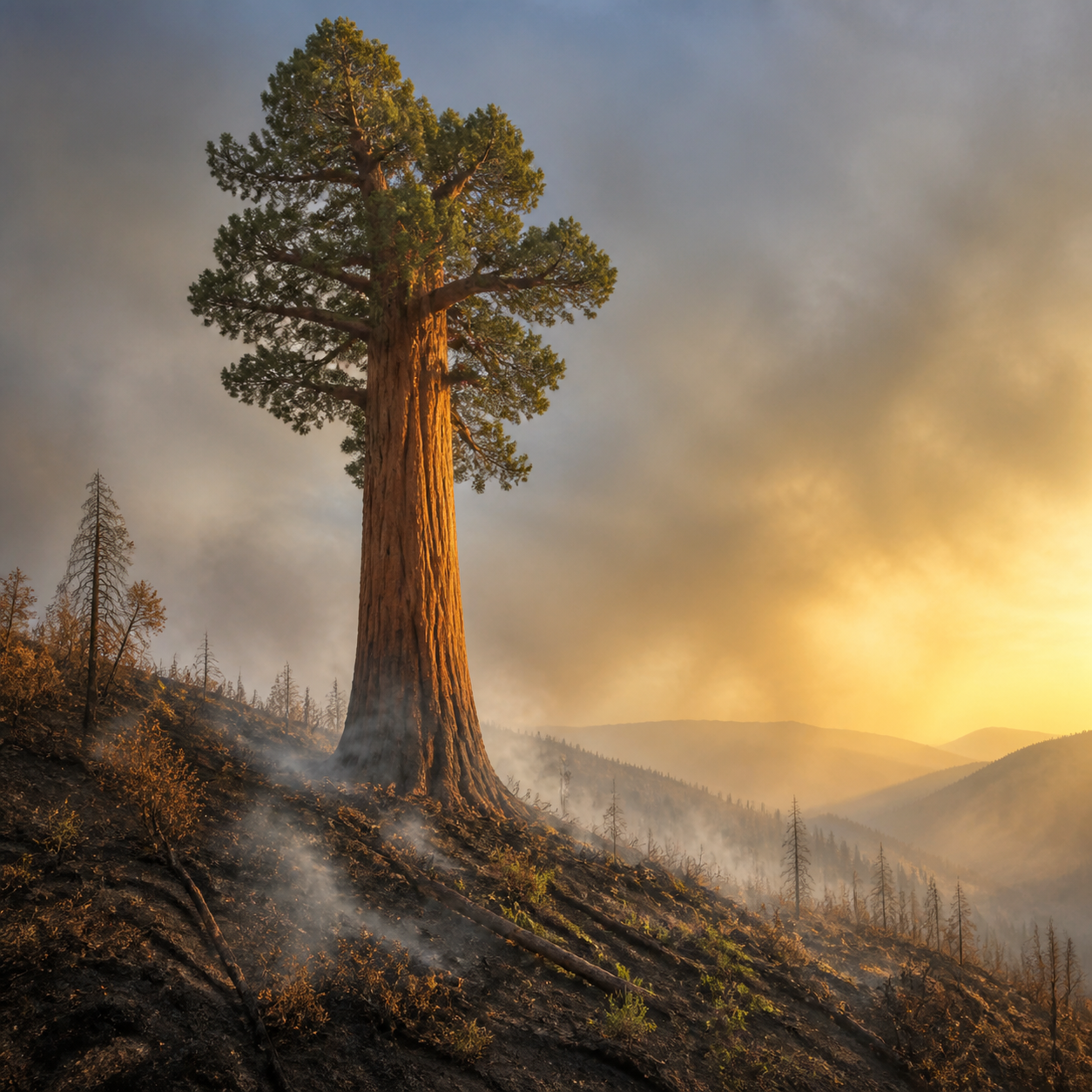
What struck me most, though, wasn't the local fire itself. It was what was left behind. The fires here tore through the brush and bracken, scorching the hillsides black. But the trees? They're still standing. Blackened at the base, perhaps, but standing tall, branches still reaching for the sky as if nothing happened.
It reminded me of a trip Jason and I took to California several years ago, where we stood underneath the giant sequoias and learned something that rearranged how I think about fire. Those massive trees actually need fire to survive. Their cones won't release their seeds properly without the heat of a fire to dry them out and pop them open. Fire clears away the competing underbrush so sequoia seedlings can get sunlight and grow. And mature sequoias have bark up to two feet thick, built specifically to shrug off flames that would flatten anything else. When fire sweeps through, it doesn't kill the sequoia. It removes the sequoia's competition, feeds the soil, and afterward, the tree grows faster and stronger than before, more resistant to whatever fire comes next.
I can't stop thinking about how backward that seems. We assume fire only destroys. But for the sequoia, fire is the very thing that makes it a giant.
Sound familiar? Peter wrote something similar to persecuted, scattered believers who desperately needed to hear it:
"That the trial of your faith, being much more precious than of gold that perisheth, though it be tried with fire, might be found unto praise and honour and glory at the appearing of Jesus Christ" (1 Peter 1:7).
Peter wasn't being poetic. He was telling them the fire isn't random, and it isn't wasted. It's refining.
Here's what really impresses me about the sequoia illustration, though. The fire doesn't just fail to hurt the trees. It actively makes the trees stronger and more resilient for the future.
That's more than just surviving a trial. That's being built up by it.
When God allows fiery trials into our lives, whether it's grief, financial strain, health scares, or just the slow burn of daily discouragement, He isn't simply helping us limp through unscathed. He's using that heat to burn away the underbrush crowding our spiritual growth: pride, self-reliance, misplaced priorities, and half-hearted devotion. Fire clears it all out so the roots of our faith can reach deeper.
And just like the sequoia's thick bark develops over time, resilience isn't something we're born with. It's cultivated one fiery season at a time. James put it plainly:
"My brethren, count it all joy when ye fall into divers temptations; Knowing this, that the trying of your faith worketh patience" (James 1:2-3).
Notice he didn't say to count it convenient or comfortable. He said to count it a joy, because he understood what was happening beneath the surface. Every trial we endure by faith adds another ring of strength, another layer of trust, and another inch of bark that makes us less flammable the next time the sparks fly.
So when the fires of life come, and they will, don't waste your energy wondering why God let this happen. Ask instead what He wants to grow from it. The bracken has to go before the branches can flourish. Let Him burn away what's holding you back, because on the other side of that fire is a faith that stands taller, roots deeper, and resists more than it ever could before.
🔍 PULLING BACK THE CURTAIN: A Peek at the Study Behind This Post
This one started with a headline, not a Bible verse: the news that Wales just had its driest July since records began in 1836, paired with the sight of blackened bracken on a hillside near our home where the trees themselves were still standing green.
Step 1: Noticed the anomaly. I kept seeing fire damage that stopped at ground level. The undergrowth was toast, but the trees looked untouched. That contrast nagged at me, so I started digging into why that happens instead of just accepting it.
Step 2: Chased the California memory. I remembered our sequoia trip and thought, Wait, don't those trees actually need fire? I looked up giant sequoia fire ecology and found the science: their cones require heat to open and release seed, fire clears shade-competing plants, and mature bark can run up to two feet thick specifically to survive burns that kill everything around them.
Step 3: Went looking for a fire verse that wasn't the obvious one. My instinct was to reach for the three Hebrew children in the fiery furnace or "when thou walkest through the fire" in Isaiah 43:2, but that felt too expected. I pulled up 1 Peter 1:7 instead, since I remembered Peter wrote to believers who were literally being scattered and persecuted, and the "tried with fire" language fit the sequoia picture almost too perfectly.
Step 4: Cross-referenced for a second angle. I didn't want the devotion to lean on one verse alone, so I went to James 1:2-3 to see how it complemented Peter's idea. James adds the "why," the trying of faith producing patience, which gave the devotion its forward motion rather than just repeating "trials are good for you."
Step 5: Let the metaphor set the structure. Once I had "fire clears competition" (pride, self-reliance) and "bark thickens over time" (built-up resilience), the whole application basically wrote itself in two movements instead of one repeated point.
Time note: All told, maybe 40 minutes, most of which was spent double-checking sequoia bark thickness because I did not want to get called out by a forestry major in the comments.
Try this yourself next time something in nature or the news catches your eye: ask "why does this work the way it does," look up the actual mechanism, then go hunting in Scripture for a verse that matches the mechanism rather than the obvious moral. There's treasure sitting right under the surface of stuff you already noticed today. Go dig.