When Later Becomes Never
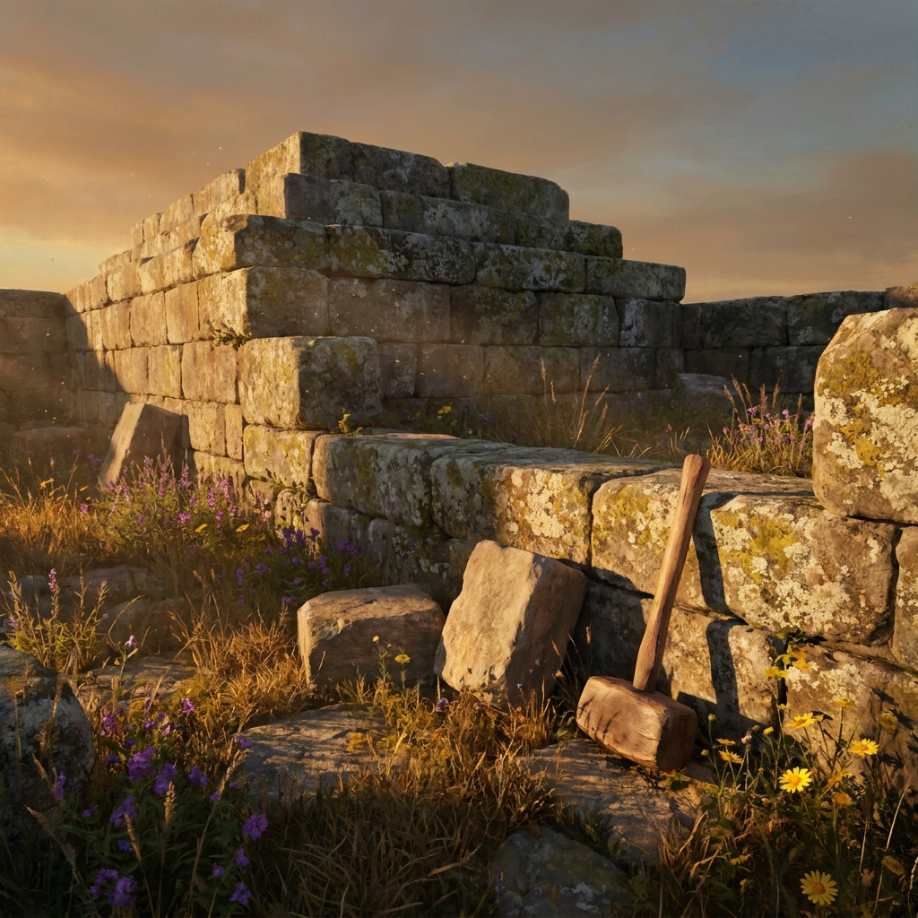
Have you ever put something off, telling yourself you'd "get to it later," only to discover that later, the job had grown three sizes bigger and twice as stubborn? Oh, friend, do I have a story for you, and it comes straight from the pages of the Old Testament, tucked into the often-overlooked books of Ezra, Haggai, and Zechariah.
When the Israelites finally returned home from their seventy years of Babylonian exile, they had one big, holy assignment waiting for them: rebuild the temple. And bless their hearts, they actually started strong! They gathered together "as one man" in Jerusalem, set up the altar, and laid the foundation of the Lord's house with singing and shouts of joy so loud that some couldn't tell the weeping from the celebrating (Ezra 3:1, 10-13). It was a beautiful, hopeful beginning.
But then opposition showed up, the way it always seems to. The people already living in the land grew nervous about this rebuilding project and set out to discourage the workers. Scripture says they "weakened the hands of the people of Judah, and troubled them in building" (Ezra 4:4), even going so far as to hire counselors against them and write letters of accusation to the Persian king. And here's the part that gets me every time I read it. The work didn't just pause for a few weeks or limp along through one rough season. It stopped cold and stayed stopped for roughly sixteen years (Ezra 4:24).
Sixteen years! Can you imagine walking past that half-built, weed-choked foundation every single day for sixteen years, telling yourself, "I'll get back to that eventually"? I bet after year one, it looked merely discouraging. After year five, it probably looked downright hopeless. And by year sixteen, I wouldn't be surprised if most folks had simply stopped seeing it at all. It had become part of the scenery, a monument to good intentions that had long since gone stale, gathering dust right alongside their guilt.
Then along comes the prophet Haggai with a message that must have stung like a swat on the backside.
"Is it time for you, O ye, to dwell in your cieled houses, and this house lie waste?" he asked them point blank (Haggai 1:4).
In other words: "Y'all built yourselves nice, cozy homes with fancy paneling, and you left God's house sitting in rubble all this time. Really?" God didn't stop there, either. He told them plainly to "consider your ways" (Haggai 1:5), a phrase that in the original Hebrew literally means to set your heart upon something, to stop and truly examine it rather than glance past it for the hundredth time. And when they finally did consider their ways, they discovered their fields were failing, their wages were vanishing "into a bag with holes" (Haggai 1:6), and nothing they touched seemed to prosper the way it should.
Their procrastination hadn't merely delayed a building project sitting out on a hillside somewhere. It had quietly drained the joy and blessing right out of their everyday lives, and most of them probably never connected the dots until Haggai spelled it out for them.
Isn't that just how procrastination works on us too, though? We tell ourselves we're only pushing something to tomorrow, a small, harmless delay. But tomorrow has a sneaky way of multiplying into next week, then next month, then years we can hardly account for. And the task we set aside doesn't politely wait for us in the same condition we left it. It grows. It calcifies. It gains weight the longer it sits.
Think about it in practical terms. The hard conversation we keep postponing with a family member doesn't get easier with time. The silence between you only grows more awkward and layered with unspoken hurt, until neither of you quite remembers how to bring it up anymore.
The bad habit we tell ourselves we'll deal with "after this next season" digs its roots deeper into our daily rhythms the longer we let it run unchecked, until pulling it out feels less like breaking a habit and more like performing surgery on ourselves.
The dream or calling God placed on our hearts years ago gets buried under an ever-thickening layer of doubt, busyness, and "someday," until we're not even sure we remember what it felt like to be excited about it in the first place.
And here's what strikes me most about the Israelites' long delay: it wasn't only the temple that suffered from their neglect. It was them. Haggai makes abundantly clear that their procrastination boomeranged right back into their own lives, souring their harvests, hollowing out their contentment, and leaving them chasing wages that disappeared before they could even spend them.
Friend, that is exactly what happens when we let obedience gather dust on a shelf somewhere in our hearts. The unfinished business we've shelved doesn't sit quietly in the corner, patiently waiting for a more convenient day. It leaks. It seeps into everything else we're trying to build. It shows up as that low hum of unease we can't quite name, the thing that keeps us tossing at two in the morning, the reason we can't fully enjoy the comfortable "paneled houses" of our own distractions, because some part of us already knows exactly what we're avoiding and exactly what it's costing us.
This is true whether the delay is literal, like a house project half-finished in the garage or a stack of unpaid bills growing on the counter, or whether it's entirely internal, like a resentment we've nursed instead of releasing, or a step of faith we've talked ourselves out of taking one more time. Either way, the principle holds. Delay rarely shrinks a task. It almost always makes it heavier, messier, and harder to face by the time we finally circle back around to it.
But the good news is that Haggai's story doesn't end in shame or in sixteen more years of standing still. Once the people got their hearts right, Scripture tells us that "they came and did work in the house of the LORD" (Haggai 1:14), turning years of avoidance into simple, immediate action. The prophet Zechariah, ministering alongside Haggai during this same season, cheered the people on with a promise straight from the Lord: "the hands of Zerubbabel have laid the foundation of this house; his hands shall also finish it" (Zechariah 4:9). What sixteen long years of putting-off couldn't accomplish, a handful of months of renewed obedience finally did. The temple that had sat abandoned for over a decade and a half was completed within about four years of the people simply picking up their tools again (Ezra 6:15).
So let me ask you the same question Haggai's words have been asking me all week: what's your temple? What is the thing you've been walking past day after day, telling yourself you'll deal with it later, once things settle down, once you feel more ready? Maybe it's a relationship that needs mending before more years slip by unspoken. Maybe it's a calling you've been dodging because it feels too big or too risky. Maybe it's simply the daily discipline of unhurried time with the Lord, the kind we always mean to get back to "starting tomorrow."
Whatever it is, let's learn from Judah's sixteen wasted years instead of living out our own version of them. The task will not get easier by waiting on it. It never does. But the moment we finally pick up the tools again, in faith and obedience, God is already there, ready to meet us in the rubble and help us finish what we started so long ago.
Consider your ways, friend. Then get building.
🔍 Pulling Back the Curtain: A Peek at the Study Behind This Post
Again, I have to give credit to my husband, Jason, for the idea behind today’s devotion. It all started with his sermon and the fact that the temple sat unfinished for roughly sixteen years. Sixteen! I couldn't get that timeframe out of my head, and I knew there had to be a devotion hiding in it. But frankly, Jason did most of the work on this one, so I want to give him the credit he deserves. Here’s approximately what his preparation looked like:
The initial spark: He was reading Ezra 4 and hit verse 24, which says the work "ceased" until the second year of Darius. He stopped and did the math against Ezra 3, where the foundation was laid years earlier, and realized just how long that gap actually was. A whole season of life, gone, with the project just sitting there.
Cross-referencing the timeline: He pulled up a study Bible timeline and a couple of commentary sites to confirm the dates: the return happened around 538 B.C., the foundation was laid around 536 B.C., work stalled by roughly 534 B.C., and it didn't resume until 520 B.C. under Haggai and Zechariah's preaching. Watching those dates stack up made the delay feel real, not just a Bible-trivia fact.
Chasing the "why": He wanted to know why the people stopped, so he dug into Ezra 4 and found the opposition from the "people of the land," who discouraged the builders and hired counselors against them. But then Haggai 1 revealed something even more convicting: the people weren't only stopped by outsiders; they'd also gotten comfortable and stopped caring, building their own paneled houses instead (possibly even with some of the materials that had been set aside for the temple).
The moment it crystallized: When he read Haggai 1:6, about wages disappearing "into a bag with holes," he realized this wasn't just an ancient building story. It was a perfect picture of how procrastination doesn't just delay a task; it drains the life out of everything around it. That's when the sermon clicked into place for him (and the devotion for me).
Time note: I honestly don’t know how long Jason spent preparing for his sermon, but I do know there was a lot of research involved. For me, since he had done most of the research, I basically took the idea and ran with it, getting only mildly distracted by a rabbit trail that led me to Aesop’s fable about the ant and the grasshopper. (What can I say? I love stories!)
Your turn: If you've ever read a Bible passage and thought, "Wait, how long was that?" — pull on that thread! Grab a study Bible or a free online commentary, look up the timeline, and ask what the delay cost the people involved. You'll be amazed how a simple date range can crack open a whole devotional treasure chest.