Carrying Others’ Burdens Without Being Crushed
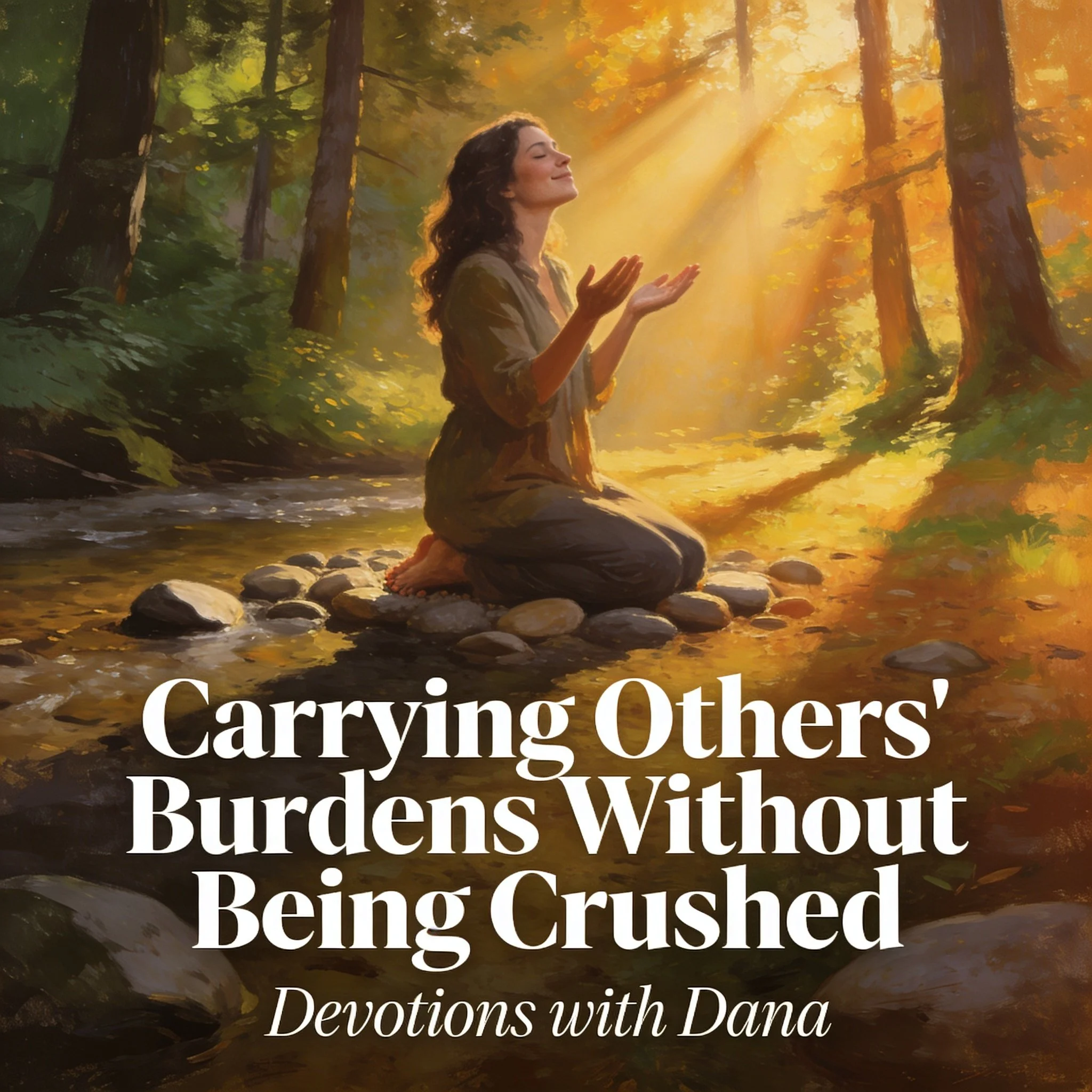
You know the feeling. Your phone rings, and even before you answer, your shoulders tense up. Somebody needs something…again. And you love them. You really do. But somewhere between the third crisis this week and the fact that you haven't slept well in days, you catch yourself wondering if maybe you're just done with it all. And then you feel guilty for thinking it.
If that's you today, friend, pull up a chair. We need to talk.
Here's the thing nobody tells you when you sign up for loving people well: compassion, if you're not careful, can crush you. Not because something is wrong with you, but because you are human, with a finite supply of strength, emotional bandwidth, and, let's be honest, patience. You were never designed to carry the weight of the world. That job was already taken.
As we discussed in a previous devotion, the Bible does not contradict itself in Galatians 6 when it tells us to bear one another’s burdens and then to let every man bear his own burdens. It's drawing a line between helping to lift and carrying everything forever. You were made for the first. Only God can do the second.
And here's your proof: Jesus Himself could not, or rather, would not, meet every need in front of Him twenty-four hours a day without stopping to refuel.
Read this and let it sink in. In Mark 1, Jesus had what can only be described as an absolutely insane day. He preached in the synagogue, cast out a demon, healed Peter's mother-in-law, and then spent the entire evening healing everyone who came to the door. The whole city, the Bible says. The whole city!
And what did He do the very next morning? "And in the morning, rising up a great while before day, he went out, and departed into a solitary place, and there prayed." (Mark 1:35) He withdrew. He stepped away. He went to be alone with His Father.
And then—here's the part that gets me—when the disciples came to fetch Him, saying "All men seek for thee," Jesus didn't rush back. He said, "Let us go into the next towns, that I may preach there also: for therefore came I forth." (Mark 1:38) He left people behind. Not because He didn't care, but because He understood His mission, His limits, and His Source.
Friend, if the Son of God built withdrawal and prayer into His daily rhythm, you are not being selfish when you do the same. You are being wise.
But let me gently push back on one thing. The goal is not to harden your heart. The goal is not to stop caring. The goal is to stop playing God. There is a world of difference between closing off your heart and releasing what was never yours to carry in the first place. When you try to be someone's everything, you actually rob them of the chance to find their everything in Him.
Psalm 55:22 says, "Cast thy burden upon the LORD, and he shall sustain thee." Not "cast it onto your most compassionate friend." Cast it onto the Lord. When you absorb everyone's pain with no outlet to pour it out before God, you become a reservoir with no drain, and eventually, something overflows. Bitterness. Resentment. Burnout.
So here's a practical pattern from the life of Christ that might change your whole week:
Engage deeply. Then withdraw intentionally. Love fiercely. Then pray strategically. Help lift the crushing weight. Then hand the ongoing load gently and lovingly to the only One who can carry it all the way home.
You are not abandoning anyone by taking care of your own soul. You are choosing to remain a vessel that has something left to pour.
Isaiah 40:29 says, "He giveth power to the faint; and to them that have no might he increaseth strength."
He replenishes what's been spent. But you have to come to Him long enough to let Him do it.
Go ahead. Put it down for a little while. He's got it. He always did.
🔍 PULLING BACK THE CURTAIN: A Peek at the Study Behind This Post
It started with an exhausting week of playing “the sounding board” for several people who just needed someone to talk to. I didn’t mind being there for them. I wanted to help in any way I could. However, after the fourth person dumped their problems in my lap, I could feel my soul growing heavier. That led me to the question: Can I show compassion to others without putting myself at risk?
Step 1 – The Initial Observation: I re-read Galatians 6:2 and 6:5 side-by-side, and reminded myself of the lesson I learned earlier about how the word translated “burden” was not the same word in each of the verses.
Step 2 – Finding the Pattern in the Gospels: With the concept of "limits on burden-bearing" in hand, I went looking for how Jesus modeled it. Mark 1 became the anchor passage because it was fresh in my mind from a recent sermon I heard. It shows a breathtaking sequence where Jesus heals an entire city's worth of people and then, the very next morning, slips away to pray in a solitary place. I cross-referenced this with Luke 5:16 ("And he withdrew himself into the wilderness, and prayed") to confirm it wasn't a one-time event but a pattern.
Step 4 – The Rabbit Trail to Isaiah 40: Searching for promises of renewal and replenishment for the weary, I landed in Isaiah 40. Verse 29 ("He giveth power to the faint") perfectly closed the loop and reminded me there is a Source of strength for those who keep coming back to Him.
Step 5 – The Moment It Crystallized: The devotion snapped into focus when I realized the practical application isn't "care less." It's "carry differently." That reframe — from burden-absorber to burden-lifter who regularly releases to God — made the whole thing come alive.
Time invested: About 2 hours of study, plus a very long time thinking it over.
Want to try this yourself? Next time you find a seeming contradiction in Scripture, don't skip past it. Run toward it. Pull out a concordance, look up the original words, and see what's hiding there. You might just find a whole devotion waiting inside one tiny translation choice. Happy digging!