Choosing the Swine Over the Savior?
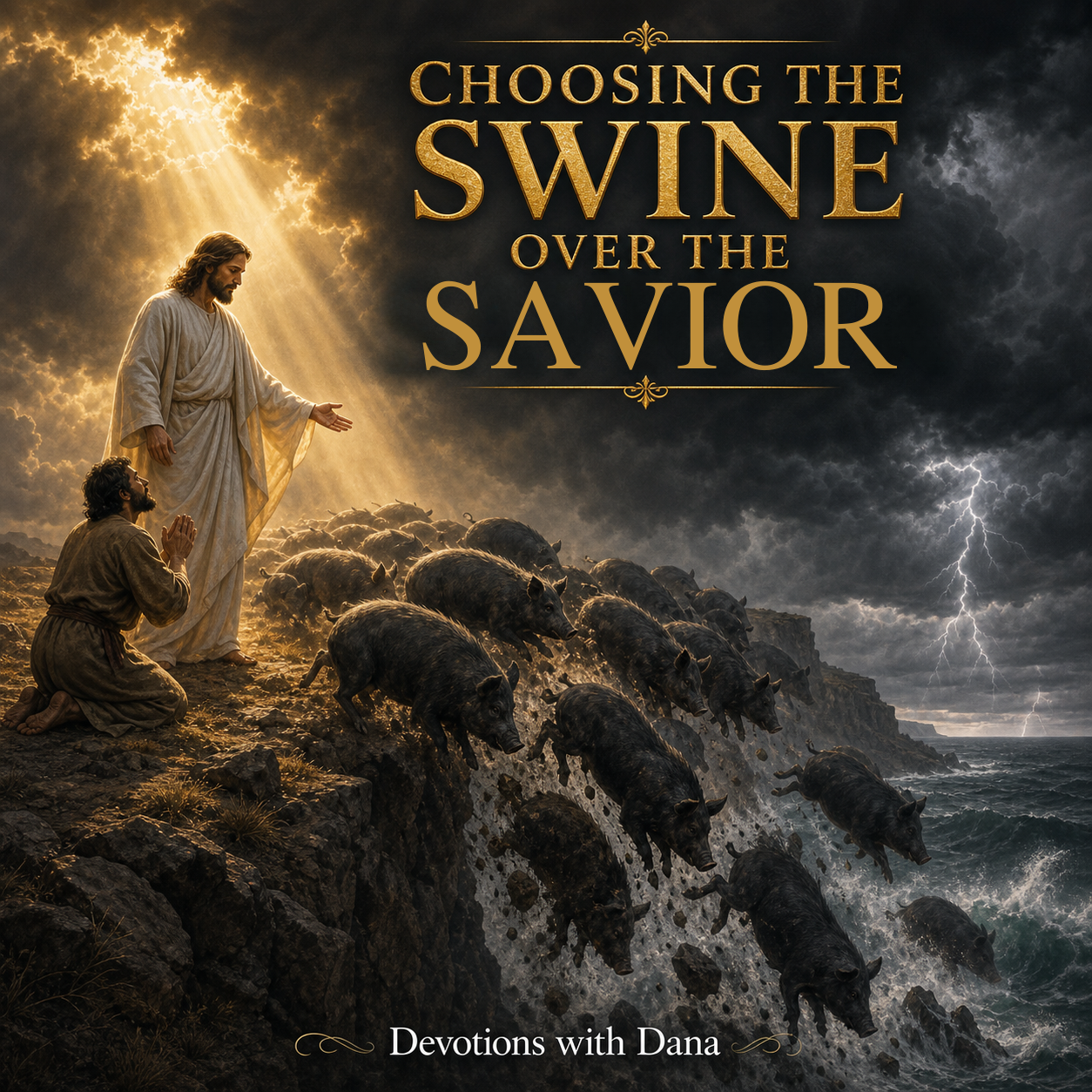
In Mark chapter five, we find one of the most dramatic scenes in all of Scripture. Jesus and His disciples have just stepped off a boat onto the shore of the Gadarenes, and before the disciples can even shake the sea spray off their sandals, a wild man comes screaming out of the tombs. We're talking wild! No clothes. No chains strong enough to hold him. Living among the dead, and cutting himself day and night. The people of the region had given up on this man. He was a lost cause. A hopeless case. But Jesus? Jesus didn't even flinch.
In the blink of an eye, the Lord cast out a legion of demons. The man who had terrorized the countryside was suddenly sitting at the feet of Jesus, clothed and in his right mind. It was the miracle of the ages. The townspeople should have been throwing a party!
But here's where the story gets strange...well, stranger. The demons, you see, had asked Jesus to send them into a nearby herd of two thousand pigs, and Jesus permitted it. Down the hillside went the whole squealing stampede, straight into the sea. Gone. Every last one. What a waste of good bacon!
Well, when the townspeople heard what had happened, they came out to see for themselves. They saw the man. They saw Jesus. And then, the Bible says in Mark 5:17, "they began to pray him to depart out of their coasts."
They asked Jesus to leave. Why? Because their pigs were gone.
They chose the swine over the Saviour.
Now, I promised not to laugh at them, so I won't. Because the truth is, we do it too. Every single day. We just use different pigs.
Maybe your pigs are your comfort zone, the safe, familiar life you've built up so carefully that you won't let Jesus rearrange a single thing. Maybe your pigs are a grudge you've been feeding for years, a sin you've decided you just can't give up, or a plan you've made that doesn't include room for what God might want instead. Maybe your pigs are your schedule, your finances, or your reputation, things good in themselves, but things we quietly value more than the presence and lordship of Christ.
Here's what strikes me about the Gadarenes: they witnessed the greatest miracle many of them had ever seen. A man completely transformed by the power of Jesus. And they still looked at their loss and said, "No, thank you." The cost was too high.
It makes me wonder how often Jesus shows up powerfully in our lives, clearly working, clearly moving, clearly calling us deeper, and we say, "That's wonderful, Lord, but this is going to cost me too much"?
The Apostle Paul had it right when he wrote in Philippians 3:8, "Yea doubtless, and I count all things but loss for the excellency of the knowledge of Christ Jesus my Lord: for whom I have suffered the loss of all things, and do count them but dung, that I may win Christ."
Dung. That's what Paul called everything that wasn't Christ. Not just worthless. Worse than worthless. And Paul wasn't speaking from a comfortable armchair, either. He'd lost everything the world considers valuable. And he still called it a bargain.
The Gadarenes made their choice. The demoniac made his. He begged to stay with Jesus. Two thousand pigs or the Saviour of the world. When it's put that way, the choice seems obvious.
But how many of us are still standing on the shoreline, looking down at our "pigs" (whatever they may be) and quietly whispering, "Lord, please don't take those"?
Today, I want to challenge you to do a little pig inventory. What are you holding onto more tightly than you're holding onto Jesus? What would you quietly ask Him to leave rather than surrender?
Because, friend, He is worth more than all the pigs in the world.
🔍 PULLING BACK THE CURTAIN: A Peek at the Study Behind This Post
It started with a herd of pigs going off a cliff and the shocking reaction of the people who watched it happen.
The initial observation: Reading Mark 5:1–20, the miracle itself grabs all the attention, but it was verse 17 that stopped me cold: the townspeople asked Jesus to leave. That's the verse that launched this whole study. Why would anyone ask Jesus to go?
The question that drove the research: What were the pigs worth? A quick search reveals that a herd of 2,000 pigs in first-century Palestine represented enormous wealth, likely the livelihood of multiple families. That one detail reframes the whole passage. Their request suddenly makes financial sense, even if it makes no spiritual sense.
The rabbit trail: That contrast between the delivered man (who begged to stay with Jesus) and the townspeople (who begged Jesus to go) is striking. Cross-referencing with Luke 8:26–39 — the parallel account — adds the detail that the man was sent back to his own city to testify. Jesus turned his tragedy into a mission. Meanwhile, the people who chose their pigs never got to see what came next.
The key connection: Philippians 3:8 — Paul's "dung" verse — surfaced in a word search for "loss" and "count." It became the theological backbone of the application. Paul lived what the Gadarenes refused: giving up earthly valuables for the surpassing worth of Christ.
The crystallizing moment: The devotion came together around the question: What are my "pigs"? That's the universal point of application because everyone has them. The pig is whatever we value more than Jesus in a given moment.
⏱️ Total study time: about 90 minutes, including cross-referencing Luke's parallel account, a Greek word check on "began to pray" (which literally means they urgently implored Him), and a rabbit trail into first-century pig farming that was fascinating but mostly ended up on the cutting room floor.
Ready to try this yourself? Next time a verse makes you pause, even for a second, don't just keep reading. Stop right there. Ask why that detail is in the text. Then start pulling the thread. You might be surprised where it leads. Hand yourself a shovel and start digging. The treasure is in there. I promise.