Do I Really Need To Do My Part?
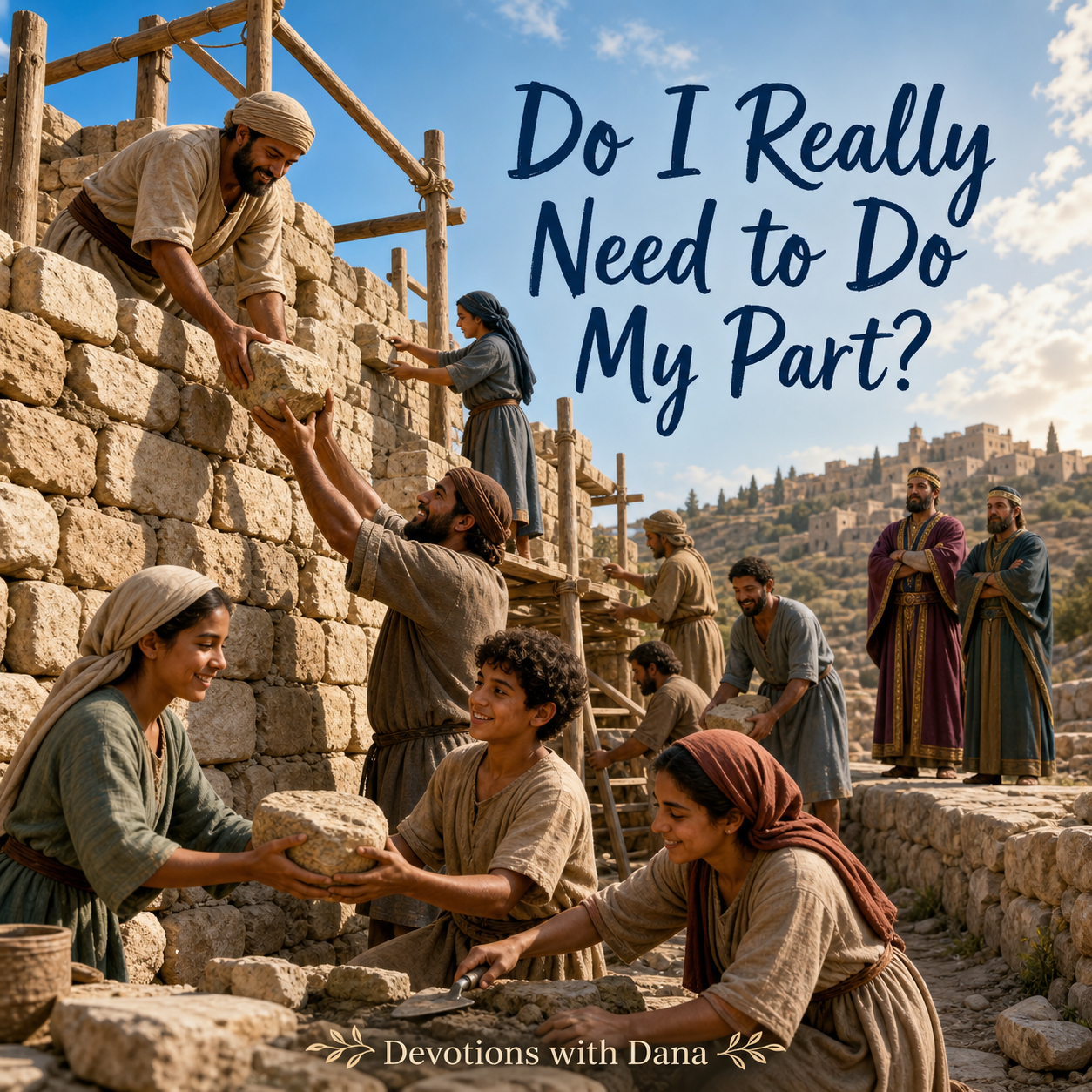
When you hear the word "construction crew," what do you picture? Big burly builders in hard hats? Perhaps a guy with a clipboard who seems to know what he's doing, and everyone else just getting in the way?
That's not what we see in Nehemiah. When the rebuilding of Jerusalem's wall began, the "crew" was... everyone. Goldsmiths. Perfume makers. Priests. Merchants. Dads. Daughters. People probably more familiar with frying pans than hammers. Chapter 3 reads like a holy roll call of ordinary folks doing an extraordinary thing: obeying God and working side by side.
And right in the middle of all that enthusiasm, we bump into one sad little line:
"And next unto them the Tekoites repaired; but their nobles put not their necks to the work of their Lord." - Nehemiah 3:5
Everyone else is shoulder-to-shoulder, sweating in the sun, stacking stones for the glory of God. But the nobles of Tekoa are standing off to the side, arms crossed, apparently too important to get their hands dirty. They enjoyed the safety of the wall when it was done, but they wanted no part in the strain of building it.
Unfortunately, that attitude persists today. The New Testament presents a different vision of how it's supposed to look:
"For as the body is one, and hath many members, and all the members of that one body, being many, are one body: so also is Christ." - 1 Corinthians 12:12
We're not all eyes. We're not all hands. We're not all mouths (though some of us talk enough to qualify). God has placed each of us in the body on purpose, with a unique role that no one else is designed to fill.
In Nehemiah's day, some people worked on the section right in front of their house. Some hung doors. Some set beams. Some repaired towers. Their work didn't all look the same, but it all mattered. In the same way, not everyone will stand behind a pulpit or teach a class, but the one who prays faithfully, encourages quietly, cleans unnoticed, gives sacrificially, or listens patiently is just as necessary to the "wall" God is building today.
And here's an even more humbling truth: when it came to salvation, there was only one Worker who could do the job. Only Jesus Christ, God the Son, lived a perfect, sinless life. Only He could die in our place.
"For when we were yet without strength, in due time Christ died for the ungodly." - Romans 5:6
We were "without strength." No tools, no materials, and no means to repair the ruin of our sin. Imagine if Jesus had taken the attitude of the nobles of Tekoa: "This isn't My mess. I'm not putting My neck to that work." Where would we be? Lost. Hopeless. Forever separated from God.
But He did precisely the opposite. He humbled Himself, took on flesh, and went all the way to the cross for us.
"But God commendeth his love toward us, in that, while we were yet sinners, Christ died for us." - Romans 5:8
If the Savior was willing to give everything to rescue us when we could do nothing, how can we, His redeemed people, stand idly by with crossed arms while the work of God goes on around us?
Your part might look small to you, but God sees it. He recorded perfumers and daughters and stubborn nobles in Nehemiah's book. He is just as aware of the nursery worker, the prayer warrior, the faithful giver, the quiet encourager. And He also sees when we "put not our necks to the work of our Lord."
The question isn't, "Do I have a part?" According to Scripture, you do. The question is, "Am I willing to do it?"
If Jesus was not too good, too busy, or too important to stoop into our mess and do the work only He could do, surely I can pick up my stone, step into my spot on the wall, and joyfully do the work He's given me.
Question for you: If your local church were pictured as Nehemiah's wall, what "section" might God be nudging you to stand in and repair—prayer, encouragement, serving, giving, teaching, something else?
🔍 PULLING BACK THE CURTAIN: A Peek at the Study Behind This Post
This devotion started with one tiny, easily overlooked phrase: “but their nobles put not their necks to the work of their Lord.” It bugged me, but in the best way.
Zoom in on the odd detail: While reading Nehemiah 3, the long list of names and jobs felt repetitive… until that line about the nobles of Tekoa. I paused and asked, “Why did God make sure that was recorded?”
Notice the contrast: I skimmed back through the chapter, marking all the “next unto them” and “after them” phrases. That rhythm of cooperation made the nobles’ refusal stand out even more. Everyone else is leaning in; they’re leaning back.
Connect to the church today: That naturally brought 1 Corinthians 12 to mind, so I turned there and reread verses 12–21 about one body and many members, underlining phrases like “God set the members every one of them in the body, as it hath pleased him.”
Bridge to the gospel: From “work” and “nobles”, my thoughts went to the ultimate work of our salvation. I looked up Romans 5:6–8 in my KJV Bible and focused on “without strength” and “Christ died for us.” That became the contrast: nobles who wouldn’t work vs. a Savior who did.
Turn study notes into devotion: Finally, I asked, “Where am I acting like a noble of Tekoa?” Those personal questions shaped the tone—light, honest, and a little uncomfortably real.
Total Time: This whole process took roughly 45–60 minutes, with Bible, notebook, and cross-references.
Want to try it yourself? Next time you read a “boring” list in Scripture, watch for the odd little details God includes. Circle them, chase a few cross-references, ask “Why this?” and “What does this reveal about Christ and me?” You’ll be surprised how quickly a lonely line about some ancient noble turns into a living, breathing lesson for today.