How Do I Keep Going When the Bullies Won’t Quit?
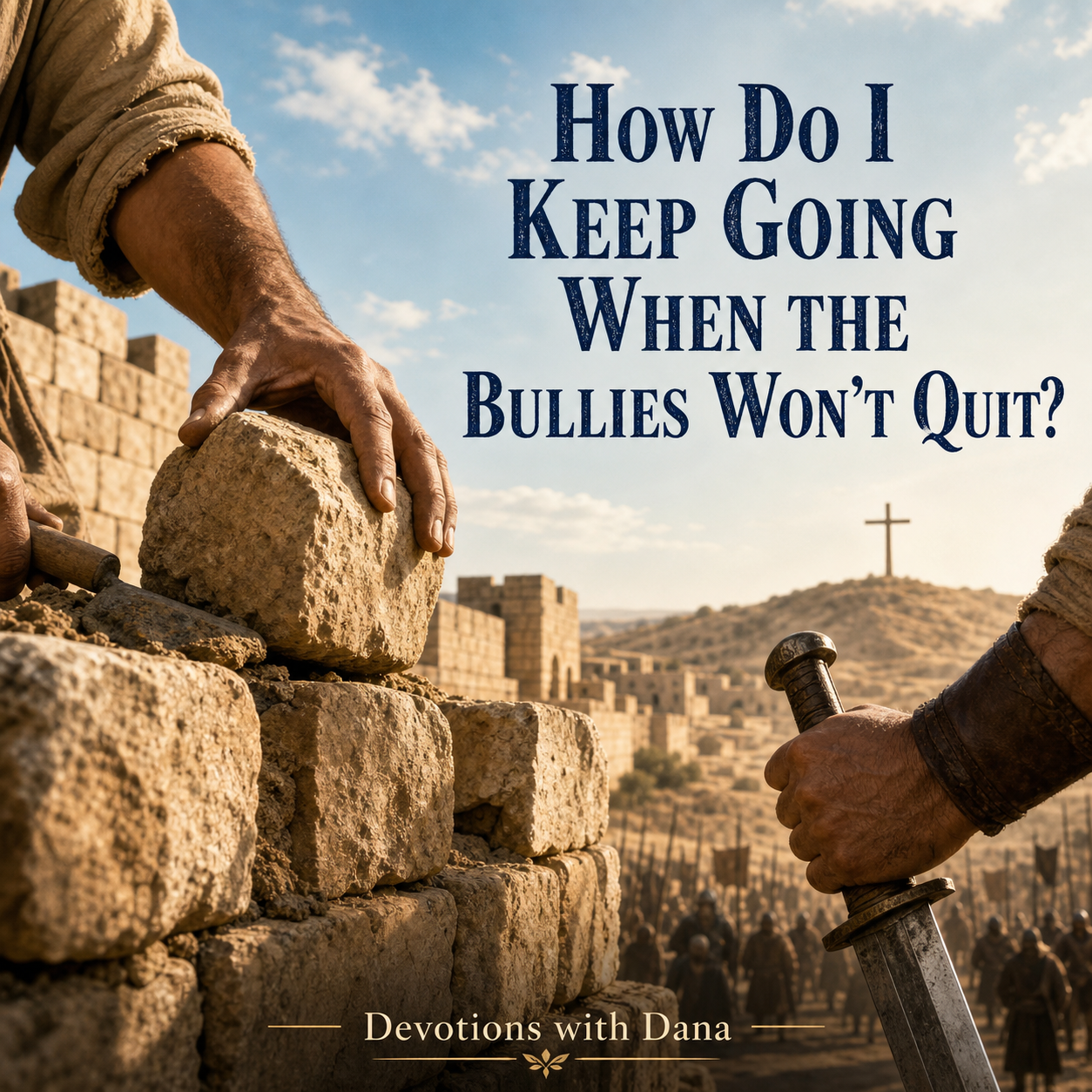
Have you ever committed to serving the Lord, only to feel as though all the trouble in the world suddenly found your address? You commit to reading your Bible, and your phone is inundated with distractions. You step out to serve, and somebody criticizes. You finally feel like you're making progress, and suddenly, discouragement, drama, or "bullies" pop up out of nowhere.
Nehemiah could relate. As the walls of Jerusalem started going up, the enemies started speaking up. Sanballat, Tobiah, and Geshem used mockery, threats, rumors, and trickery to stop the work. They mocked the Jews as weak. They suggested the wall was so flimsy that even a fox could knock it down. They plotted sneak attacks. They tried to lure Nehemiah away for a "meeting" that was really a trap.
On top of that, the people themselves grew weary. The rubble seemed endless. Their strength was failing. The enemies looked bigger by the day. In Nehemiah 4, the situation got so intense that the workers literally had to build with one hand and hold a weapon with the other.
"They which builded on the wall, and they that bare burdens, with those that laded, every one with one of his hands wrought in the work, and with the other hand held a weapon." - Nehemiah 4:17
Talk about multitasking. That's not exactly the peaceful Bible scene we like to imagine. It's sweaty, gritty, and exhausting. They didn't get to say, "Well, we're doing God's work now, so surely the attacks will stop." If anything, the opposition increased.
Sound familiar?
Sometimes we think, "If I'm in God's will and doing my best, shouldn't this get easier?" Nehemiah's story gently says, "Not necessarily." The presence of hardship doesn't mean the absence of God. In fact, it often means the work you're doing matters enough to be opposed.
How did Nehemiah handle it? He never stooped to the enemy's level. He didn't trade insult for insult. He didn't climb down into the mud-slinging. Over and over, we see this pattern: the enemy speaks, and Nehemiah prays.
When they threatened violence, he prayed and set a watch. When they mocked, he cried out to God. When they tried to lure him away from the work in Nehemiah 6, he sent this famous reply:
"And I sent messengers unto them, saying, I am doing a great work, so that I cannot come down: why should the work cease, whilst I leave it, and come down to you?" - Nehemiah 6:3
"I'm doing a great work, and I will not come down."
That sentence has carried me through more than one season of distraction and discouragement. There are times the enemy doesn't need to defeat us; he just needs to distract us and lure us away from what God has called us to do.
Nehemiah's steadfastness gives us a beautiful picture of Someone greater. Centuries later, Jesus hung on a cross outside Jerusalem's walls, paying for our sin. The crowd mocked Him too:
"If thou be the Son of God, come down from the cross." - Matthew 27:40
He saved others; Himself He would not save. They essentially said, "If you're really who you say you are, prove it and come down." But in His heart, Jesus had the same resolve as Nehemiah: "I am doing a great work, and I will not come down... not until it is finished."
He stayed on that cross, not because nails held Him there, but because love did. He endured the jeers, the pain, the shame, and the spiritual battle raging around Him, because our salvation was the "great work" He would not abandon.
So, what about us, in our own lives still under construction? We may not be facing Sanballat by name, but we face distractions, discouragement, and spiritual opposition. Sometimes serving the Lord feels like building with one hand and fighting with the other. The message of Nehemiah, and of our Savior, is this:
Keep your eyes on God, not on the bullies.
Keep your hands on the work, and your sword (God's Word) at your side.
Remember that you're part of a "great work" that stretches into eternity.
And when the enemy whispers, "Come down... quit... this is too hard...," by God's grace, we can answer:
"I am doing a great work, and I cannot come down. The work God is doing in me, and through me, is worth the battle."
Question for you: If you named your "Sanballat and Tobiah" today—your biggest distractions, fears, or bullies—what would they be, and what would it look like to answer them with Nehemiah's words instead of giving in?
🔍 PULLING BACK THE CURTAIN: A Peek at the Study Behind This Post
This devotion started with one dramatic image lodged in my mind: a worker on a wall, one hand holding a trowel and the other gripping a sword.
Revisit the scene: I went back to Nehemiah 4 and read the whole chapter in my KJV Bible, watching the tension rise from mockery to threats to full-blown battle preparation. Verses 16–18 gave me that vivid “sword and trowel” picture.
Highlight the key phrase: I underlined Nehemiah 4:17 and wrote in the margin, “Work and warfare at the same time. This feels like real life.” That became the emotional hook: serving God while still fighting off discouragement and attacks.
Follow the enemy’s tactics: From there, I jumped to Nehemiah 6 and read about Sanballat and Geshem’s invitations to meet on the plain of Ono. Nehemiah’s answer in 6:3—“I am doing a great work, so that I cannot come down”—is one of my favorite lines in all of Scripture.
Connect to Christ: The phrase “come down” nudged my memory toward the crucifixion. I turned to Matthew 27 and found verse 40, where the crowd mocks Jesus: “If thou be the Son of God, come down from the cross.” That parallel between Nehemiah’s wall and Christ’s cross shaped the heart of the devotion.
Apply to everyday life: Finally, I scribbled a list of modern “Sanballats”—distractions, fears, critics, busyness—and asked, “What would it look like to answer these with ‘I cannot come down’?” Those questions turned into the practical, conversational points you read.
Total Time: All told, this study took about an hour, which was plenty of time to read slowly, chase cross-references, and let the “great work” theme settle in.
Want to try it yourself? The next time a phrase grips you—like “I cannot come down”—circle it, follow it through Scripture, look for echoes in the life of Christ, and then name your own real-life battles. It’s like watching the Bible draw a straight line from Nehemiah’s wall, to Calvary’s cross, to your kitchen table.
To wrap up this three-part series: which of the three lessons—foundation, doing your part, or staying focused through opposition—do you sense the Lord pressing on your heart the most right now?