Is the Christian Life Supposed To Be This Hard?
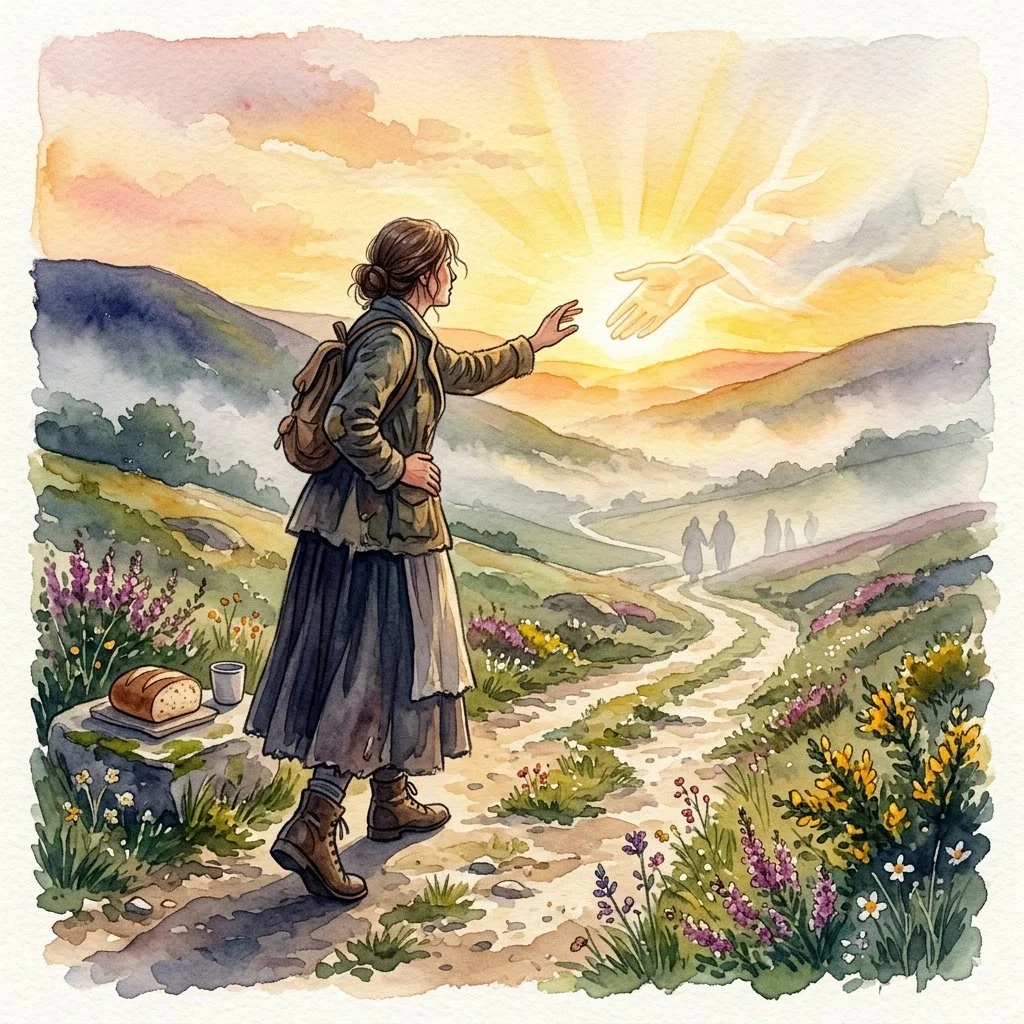
I'll admit something. For years, I pictured the Christian race as a Sunday-afternoon jog. I saw myself in cute sneakers with a gentle breeze in my hair, waving at the neighbors and admiring the scenery. "It's a marathon, not a sprint," I'd say, as if a marathon were just a sprint with better snacks.
Then I looked up the Greek word for "race" in Hebrews 12:1, and my smoothie hit the pavement.
The word is agōn, and yes, it's where we get "agony." It was the word for the contests held in the great stadiums, where athletes strained, gasped, and gave everything they had. The word carries the idea of struggle and conflict. Nobody in that arena was admiring the scenery.
The Part Nobody Puts on a Poster
We love the race verse. We put it on mugs and bookmarks. But we rarely talk about what it's like to run it on mile nineteen, with a blister, a headache, and a to-do list that's grown legs.
Day-after-day running isn't dramatic. Nobody writes songs about the morning you dragged yourself out of bed, read three verses with your eyes half shut, and whispered, "Lord, I've got nothing today." Nobody applauds the prayer you could only manage in a sigh. Most of this race is run in the unglamorous middle, where the cheering crowd has gone home, and the finish line is nowhere in sight.
The Hebrew Christians who first received this letter knew that stretch well. They had started strong. "Ye endured a great fight of afflictions," the writer reminds them (Hebrews 10:32). But years later, they were tired and drifting. So he tells them plainly, "For ye have need of patience, that, after ye have done the will of God, ye might receive the promise" (Hebrews 10:36). Notice the phrase "have need." Endurance isn't a bonus feature for super-saints. It's a basic need for everybody in the race.
So let's talk to the runners. I think I see at least three of you.
To the One Who Can Barely Take the Next Step
Oh, how I feel your pain! You're not asking for a victory lap. You're asking for the strength to put one foot in front of the other. Maybe it's grief, a diagnosis, a prodigal, a marriage, a mountain of bills, or a fog of anxiety that won't lift. You get up and do the next thing, then wonder how you'll do the next.
Let me tell you what Scripture doesn't say. It doesn't say, "Run faster." It says, "Lift up the hands which hang down, and the feeble knees; And make straight paths for your feet, lest that which is lame be turned out of the way; but let it rather be healed" (Hebrews 12:12-13). God knows about hanging hands and feeble knees. He mentions them without scolding. He even makes room for the lame runner, promising that the limp can be healed rather than disqualify him.
Isaiah says something just as tender. "He giveth power to the faint; and to them that have no might he increaseth strength" (Isaiah 40:29). Look at who receives the strength: the faint and those with no might. The qualification for receiving power is having none of your own. Then comes the verse we usually quote, with the order that matters: "They shall mount up with wings as eagles; they shall run, and not be weary; and they shall walk, and not faint" (Isaiah 40:31). Running, then walking. Sometimes the miracle isn't the soaring. Sometimes it's that you can still walk without fainting. Today, a steady walk might be the victory.
To the One Who Is Ready to Quit
I'd like to sit beside you for a moment because I've been there, too. I know the thought that whispers, "It would be easier to stop. This is just too much."
Consider Elijah. He had just seen fire fall from heaven, and then one threat from Jezebel sent him running into the wilderness, where he sat under a juniper tree and prayed to die. "It is enough; now, O LORD, take away my life" (1 Kings 19:4). That's the prayer of a worn-out runner. Look at what God did. He didn't give a lecture. He sent an angel, a nap, and a hot meal. Twice the angel said, "Arise and eat; because the journey is too great for thee" (1 Kings 19:7).
God said the journey was too great for him. He didn't say Elijah was weak or faithless. He admitted the race was bigger than one man's strength, and He supplied what was needed. Sometimes the next step of faith is rest, food, a doctor, a counselor, or a friend. Please hear me, especially if depression or anxiety is part of your race. Seeking help isn't quitting. It's following the angel's instructions.
Then fix your eyes where the passage tells you to. "Looking unto Jesus the author and finisher of our faith; who for the joy that was set before him endured the cross, despising the shame, and is set down at the right hand of the throne of God. For consider him that endured such contradiction of sinners against himself, lest ye be wearied and faint in your minds" (Hebrews 12:2-3). The word "consider" is an invitation to study His endurance, and the cure for fainting is looking at Him. He knows exactly what it is to want a different road. In Gethsemane, He asked for the cup to pass, and then He ran the hardest stretch of all for us. He didn't just start our race. He finishes it. You may be tired, but you aren't carrying the finish-line responsibility. He is.
And a promise for the long haul: "Let us not be weary in well doing: for in due season we shall reap, if we faint not" (Galatians 6:9). Notice it says "in due season." God's timing, not ours. The harvest is real, even if it's slower than we'd like.
To the One Looking at Other Runners
Then there's you. Yes, I understand you too. You glance sideways and see someone gliding along. She seems to have it all together. Her prayers sound effortless, her kids sit still in church, and her trials seem small and tidy. You wonder, "What am I doing wrong? Why is my race so much harder?"
Asaph asked the same question in Psalm 73. "I was envious... when I saw the prosperity of the wicked" (Psalm 73:3). He looked around and decided it was unfair. Then he admitted, "When I thought to know this, it was too painful for me; Until I went into the sanctuary of God; then understood I their end" (Psalm 73:16-17). The comparison hurt until he went into God's presence and saw the bigger picture. Only there did his perspective get corrected. By the end of the psalm, he was praying, "My flesh and my heart faileth: but God is the strength of my heart, and my portion for ever" (Psalm 73:26).
A few truths help when we compare. First, we see other runners' faces, not their hearts. Many are smiling through pain we can't see. Second, we don't know which lane they've been assigned, and the Bible says the race is "set before us," meaning set before each of us individually. Our course is custom-marked.
Peter fell into this trap too. After hearing Jesus' own words about his future, he glanced at John and asked, "Lord, and what shall this man do?" Jesus answered, "If I will that he tarry till I come, what is that to thee? follow thou me" (John 21:21-22). It's one of the gentlest, firmest corrections in the Gospels. "What is that to thee?" Your assignment is to follow Jesus, not to audit someone else's lane. Run your race, and leave others to run theirs.
If your struggle is heavy, it may be because He's building something in you that He's not building in anyone else. Paul begged for relief and heard, "My grace is sufficient for thee: for my strength is made perfect in weakness" (2 Corinthians 12:9). Your weakness isn't a detour. It's the place where His strength is on display.
Running It Day After Day
So what does the daily run look like? It looks like laying aside weights, both good and bad, because they slow you down. It looks like fixing your eyes on Jesus in the morning before the day's noise starts. It looks like leaning on the cloud of witnesses, fellow believers in the stands, and letting a friend carry you when you can't carry yourself. "Bear ye one another's burdens" (Galatians 6:2) applies to runners as much as to anyone.
Some days you'll sprint. Some days you'll limp. Some days, like Elijah, you'll need a nap and a sandwich (or pizza). All of it counts when your eyes are on Him.
Paul reached the end of his race and said, "I have fought a good fight, I have finished my course, I have kept the faith" (2 Timothy 4:7). He didn't say it was easy. He said he finished.
So take heart, dear runner. You're not behind or broken. You're racing. Take the next step, and let Him carry you across the line.
Go Deeper into Hebrews 12:1–2
If understanding agōn as an agonizing struggle rather than a quick sprint shifted something for you today, this is only the beginning.
In my personal study notes on Hebrews 12:1–2, I dig much deeper into the original language and context, unpacking what it really means to be surrounded by a "cloud of witnesses" (martys), how to distinguish between moral sins and non-sinful "weights" (onkos) that wear us down, and how Jesus acts as both the Trailblazer (archēgos) and Completer (teleiōtēs) of our faith.
I’ve compiled these complete, detailed notes into a downloadable Hebrews 12:1–2 Study Guide for paid subscribers.
When you upgrade to a paid subscription ($5/month or $50/year), you’ll instantly unlock this complete study guide along with my growing archive of deep-dive study resources, devotional guides, audio lessons, and other exclusive perks.
🔍 PULLING BACK THE CURTAIN: A Peek at the Study Behind This Post
This devotion began with one surprising fact I uncovered during my personal Bible study: the Greek word for "race" in Hebrews 12:1 is the root of our English word "agony." Lexicons define it as a contest, struggle, or conflict. I immediately took notice and nodded my head.
Spot the spark. "Marathon, not a sprint" made me picture a pleasant jog. I wondered whether the Greek told a different story.
Look up the word. In a Greek lexicon (Blue Letter Bible or Bible Hub are free), I found agōn, Strong's G73. Commentaries confirm it was used for athletic contests and struggle .
Chase the cross-references. I followed agōn to 1 Timothy 6:12 and 2 Timothy 4:7, where Paul uses the same word family for fighting and finishing.
Read the neighborhood. Reading Hebrews 10:32-36 and 12:1-13 showed me the original readers were tired, not just starting out. The words "have need of patience" and "hands which hang down" shaped the whole devotion.
Find the faces. I asked, "Who in Scripture ran tired, wanted to quit, or compared?" That brought Elijah (1 Kings 19), Asaph (Psalm 73), and Peter (John 21) to the table.
⏱️ Time note: The expanded version took me a couple of hours, and Elijah's nap did seem like a good idea by the time I was finished.
Your turn! Pick a verse with a word that intrigues you, look it up in the original language, and ask, "Who else in the Bible felt this?" Grab your shovel, because the treasure is real!