The God We Want vs. the God Who Is
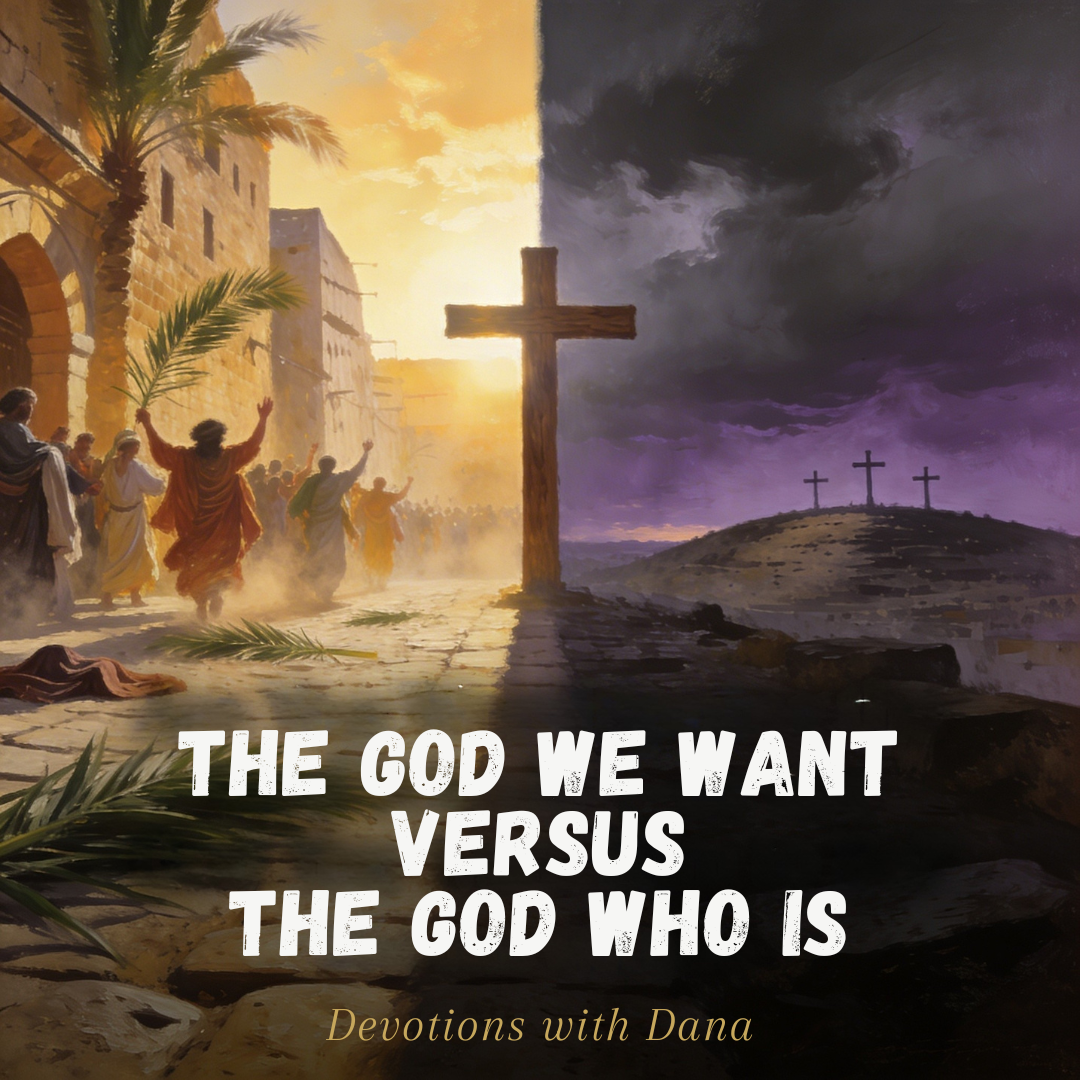
It started with palm branches and praise.
"Hosanna! Blessed is the King of Israel!" The crowd was electric. People threw their coats on the road, waved branches, and shouted themselves hoarse. If you'd been standing in that crowd on Palm Sunday, you might have thought, This is it. The revolution is here. And honestly? That's exactly what they thought, too.
The same people who had been groaning under Roman rule for generations finally saw their moment. Jesus was riding in. A miracle worker. A man who had raised the dead, fed thousands with a few fish sandwiches, and made blind men see. If anyone could overthrow Caesar's grip, surely it was Him!
And then... He didn't.
No armies. No swords drawn. No Roman soldiers sent running. Just Jesus weeping over the city, turning over tables in the temple, and talking about things like eternal life and the kingdom of Heaven. Not quite the battle plan they had in mind.
It took less than a week for those hosannas to curdle into something ugly. The very mouths that had shouted His praises were now screaming, "Crucify Him! Crucify Him!" (Luke 23:21). Same crowd. Same lips. Completely different song.
What happened?
Simple. The God who is didn't match up with the God they wanted. They wanted a political deliverer. A quick fix, a military king, a solution to their current problem. But Jesus hadn't come to deal with Roman rule. He had come to deal with something far more oppressive than Rome: the sin that had separated every human soul from a holy God since the days of Adam.
They were looking for temporary relief. He came to provide eternal redemption.
They wanted a crown. He came for a cross.
And because He refused to fit into the box they had built for Him, they turned on Him. Doubted Him. Betrayed Him. Handed Him over to be mocked, beaten, and nailed to a Roman cross like a common criminal. All because He didn't perform the way they expected.
Sound familiar?
I'd love to say we're not guilty of the same thing, but let's be honest. How many times have we praised God on Sunday morning, only to sulk in our prayer closet by Wednesday, arms crossed, wondering why He hasn't answered things our way? We come to Him with our plans already written, our preferred timeline already set, and our specific outcome already decided. And when He doesn't cooperate? We start to question. We distance ourselves. We go looking for a God who will say yes to everything we bring to Him.
But God is not a vending machine. He is not a cosmic genie waiting to grant our three wishes. He is the great I AM, the Alpha and the Omega, and His plans are not up for vote.
"For my thoughts are not your thoughts, neither are your ways my ways, saith the LORD. For as the heavens are higher than the earth, so are my ways higher than your ways, and my thoughts than your thoughts." (Isaiah 55:8-9)
Higher ways. When God's answer doesn't match our expectations, it doesn't mean He's failed. It means He's working from a vantage point we simply cannot see from down here.
The crowd on Palm Sunday had a ceiling on their faith. They could only believe in a Jesus who fit their narrative. But the real Jesus, the one who was born specifically to die, was doing something so much bigger than they could comprehend. He was purchasing the salvation of every soul who would ever live. He was crushing the power of sin and death forever. He was building a kingdom that no Roman emperor, world leader, or any amount of time could ever topple.
They wanted a better earthly life. He gave them eternal life.
Here's the hard question we need to sit with today: Are we doing the same thing? Are we only comfortable praising God when things are going our way? Do we trust His character, or just His compliance?
Real faith isn't "I trust God when He does what I want." Real faith is "I trust God even when I don't understand what He's doing." That's the faith that holds up when the palm branches are gone, and the road gets hard. That's the faith that keeps us from joining the crowd shouting "Crucify Him" the moment life doesn't go according to our plan.
He is who He IS, not who we want Him to be. And beloved, that is more than enough, and so much better than anything we could ask or think!
"Trust in the LORD with all thine heart; and lean not unto thine own understanding." (Proverbs 3:5)
🔍 PULLING BACK THE CURTAIN: A Peek at the Study Behind This Post
The seed for this devotion was actually planted by Jason. This one grew out of a sermon he recently preached, and it took root so deeply that it had to become a devotion. Sometimes the best material comes from your own household! Here's how the study unfolded from there:
Start with the story in the text. The Palm Sunday narrative lives in all four Gospels, but Matthew 21, Mark 11, and Luke 19 were the primary stops here. Reading the triumphal entry account alongside the crucifixion narrative in Luke 23 lets you feel the whiplash — Hosanna to Crucify Him in less than a week. That dramatic contrast is the heartbeat of this whole devotion.
Ask the "why" behind the crowd's flip. A quick study on the Jewish expectation of the Messiah opened up a treasure chest. The people were steeped in the hope of a Davidic king who would overthrow their oppressors (references like Zechariah 9:9, which they knew when they saw Jesus ride in on a donkey). Cross-referencing with John 6:15 (where they tried to make Jesus king by force) showed this wasn't a passing mood or fad. It was a deeply held expectation. Resources like a basic Bible dictionary and a commentary on the Gospel of John (Matthew Henry and David Guzik are always trusty companions here!) helped fill in the cultural context.
Follow the rabbit trail to the "I AM" thread. Once the question "Who is God, really?" emerged, it was impossible not to chase the I AM statements in John's Gospel (John 8:58, John 14:6, etc.) and tie them back to Exodus 3:14. God has always been insistent on being known as He is, not as people wished He were. That's an ancient theme, not a modern one.
Find the application anchor verse. The obvious landing spot might have been Proverbs 3:5-6, but the goal was to go a layer deeper. Isaiah 55:8-9 — "my ways are higher than your ways" — captures not just trust, but the reason for trust: God's perspective is simply beyond ours. That felt like the right nail to hang the message on.
Let the contrast do the preaching. The moment the devotion crystallized was realizing that the crowd's failure wasn't unbelief in Jesus. It was belief in a wrong version of Jesus. That's the mirror moment for modern readers. They didn't stop believing; they just believed in the wrong thing. Sound like anything we've done?
⏱️ Total study time: About 2 hours — one good cup of tea's worth of reading, plus another cup's worth of staring at the ceiling, thinking, and asking questions. The staring-at-the-ceiling part is non-negotiable.
Ready to try this yourself? Pick any Bible story where someone's expectations clashed with what God actually did — there are dozens — and ask the question: "What did they want, and what did God do instead?" Grab a concordance, follow the cross-references, and see what you find. You might be surprised how quickly a simple observation turns into something that speaks straight to your heart. The Bible is a treasure map, friend, and you've already got the shovel! Happy digging!!!