When You're Trying to Tune In to God (But the World Won't Turn Down)
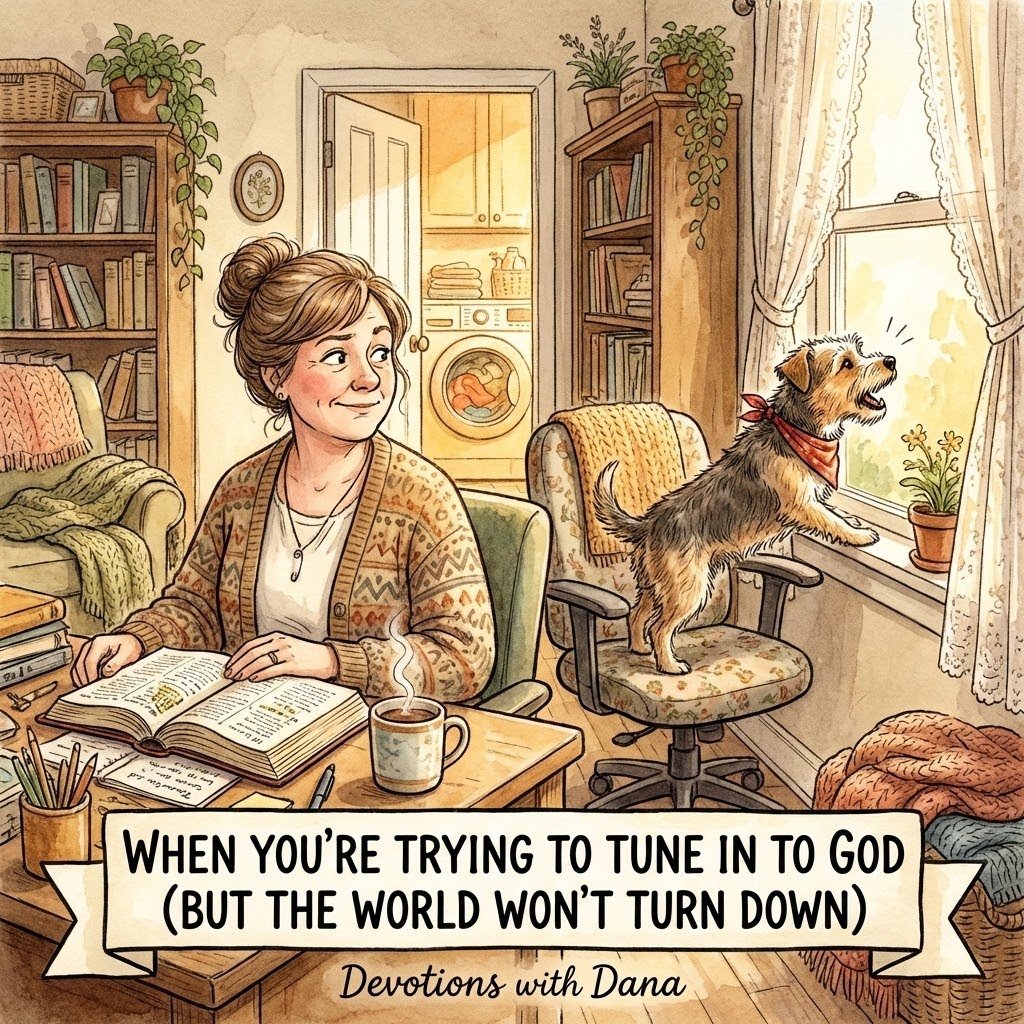
There I was, Bible open, pen in hand. With Tess snoring in her bed beside me, I was minding my own business and reading about the importance of tuning out the world to tune in to God. Very spiritual. Very focused. Very... interrupted.
Before the ink was dry on that thought, Tess launched off the floor like a furry little missile. She pressed her nose against the window and barked at some unsuspecting soul walking down the road as if the fate of the free world depended on it. Then, as if that weren't enough, she bolted from the office. Unfortunately, she pushed the office door wide open in her dramatic exit, which meant I could now enjoy the full orchestra of household chaos. Both the washing machine and the dishwasher roared directly across the hall. And Jason was happily clanging around in the kitchen. Outside, all the dogs in our neighborhood were now fully aware of the road intruder and were barking their little hearts out. Lovely!
I had just been reading about distraction. Hmm!
I had to laugh. Because isn't that just like life? You can read about trusting God, and the car breaks down. You can study patience, and the checkout line doesn't move. You can highlight a chapter on stillness, and your house turns into a three-ring circus. Reading about it is one thing. Actually doing it in the middle of real, messy, noisy life is quite another.
But here's the thing that struck me as I sat there in the middle of my very unquiet quiet time: God wasn't surprised by the barking dog or the banging pots. He never is.
In 1 Kings 19, the prophet Elijah was having his own rough moment. It wasn't a barking dog, admittedly, but rather a death threat from a wicked queen, which is arguably worse. He was exhausted, discouraged, and hiding in a cave. And God came to him. But notice how He came.
"And, behold, the LORD passed by, and a great and strong wind rent the mountains, and brake in pieces the rocks before the LORD; but the LORD was not in the wind: and after the wind an earthquake; but the LORD was not in the earthquake: and after the earthquake a fire; but the LORD was not in the fire: and after the fire a still small voice." — 1 Kings 19:11-12
Did you catch that? God was not in the wind. Not in the earthquake. Not in the fire. He was in the still small voice. And if Elijah had been fixated on all the noise around him, he would have missed God entirely.
That's our problem, isn't it? We're waiting for God to shout over the noise of our lives. Meanwhile, He's whispering right in the middle of it. The washing machine, the dog, the kitchen clatter. None of that takes God off guard or muffles His voice. The question is whether we're tuned to the right frequency.
Now, I'm not suggesting you need perfect silence to meet with God. (Because if that were a requirement, I'd never have another quiet time again.) What I am suggesting is that we stop waiting for ideal conditions and start practicing the discipline of intentional focus, even when the world around us is loud.
That word still in "Be still, and know that I am God" (Psalm 46:10) doesn't necessarily mean silent surroundings. In the original Hebrew, it conveys the idea of letting go, releasing your grip on the chaos, and refusing to give it your full attention. It's an act of the will, not a product of your environment.
So what does that look like practically? It might mean taking a slow breath and mentally handing the noise over to God before you try to read another word. It might mean praying through the interruptions instead of waiting for them to stop. It might mean recognizing that when the dog bolts, the washing machine roars, and your husband bangs around in the kitchen, that's not the enemy stealing your quiet time. That's just Tuesday.
And God meets us on Tuesdays, too.
The next time your quiet time turns into anything but quiet, don't throw your hands up. Don't wait for the house to be empty, the laundry to be done, and the dog to be napping. Just let go of the noise, lean in a little closer, and listen for that still small voice.
He's still talking. Are you still listening?
🔍 PULLING BACK THE CURTAIN: A Peek at the Study Behind This Post
It started with an almost laughably on-the-nose moment: reading about distraction in my Animals of the Bible Study, while being completely, thoroughly distracted. The dog, the washing machine, and the kitchen noise were so perfectly ironic, the idea practically wrote itself.
Here's how the study unfolded:
The irony was the spark. The contrast between reading about a spiritual discipline and living out its opposite in real time is too good to ignore. That tension — knowing vs. doing — is always rich devotional territory. That's where the digging began.
The search for Scripture. Rather than reaching for the obvious "Be still" verse right away, the first question was: Where in Scripture does God speak quietly in the middle of noise and chaos? That trail led me straight to one of my favorite stories: Elijah in the cave. The earthquake-wind-fire sequence, followed by the still small voice, is one of the most vivid illustrations of this principle in all of Scripture.
Digging into the Hebrew. A look at the Hebrew behind "Be still" in Psalm 46:10 (raphah) revealed that the word doesn't primarily mean "be silent." It means to let go, sink down, release. That reframing opened up an entirely different angle on the verse, one that's actually more applicable to noisy real life.
The cross-reference chase. From 1 Kings 19 and Psalm 46, the trail branched to other passages about God's voice and our listening posture: John 10:27 ("My sheep hear my voice"), Isaiah 30:21 ("thine ears shall hear a word behind thee"), etc. I sat with each of these verses a while.
The devotion crystallized when the raphah definition clicked into place. The lesson isn't "get a quieter house." It's "practice the discipline of letting go of the noise, regardless of your surroundings." That's a word every woman can actually use.
⏱️ Total study time: About 45 minutes — 20 minutes chasing the Hebrew rabbit trail, 25 minutes getting distracted by related passages. (The irony was not lost on me.)
Want to try this yourself? Next time life gives you an ironic, perfectly-timed interruption, don't just roll your eyes. Grab your concordance and a Hebrew/Greek lexicon (BlueLetterBible.org is free and fantastic and one of my favorite Bible study resources) and start asking why that moment felt so pointed. Sometimes the best devotions come from the moments you least expect. Happy digging! ⛏️