What Does Fruit Actually Look Like?
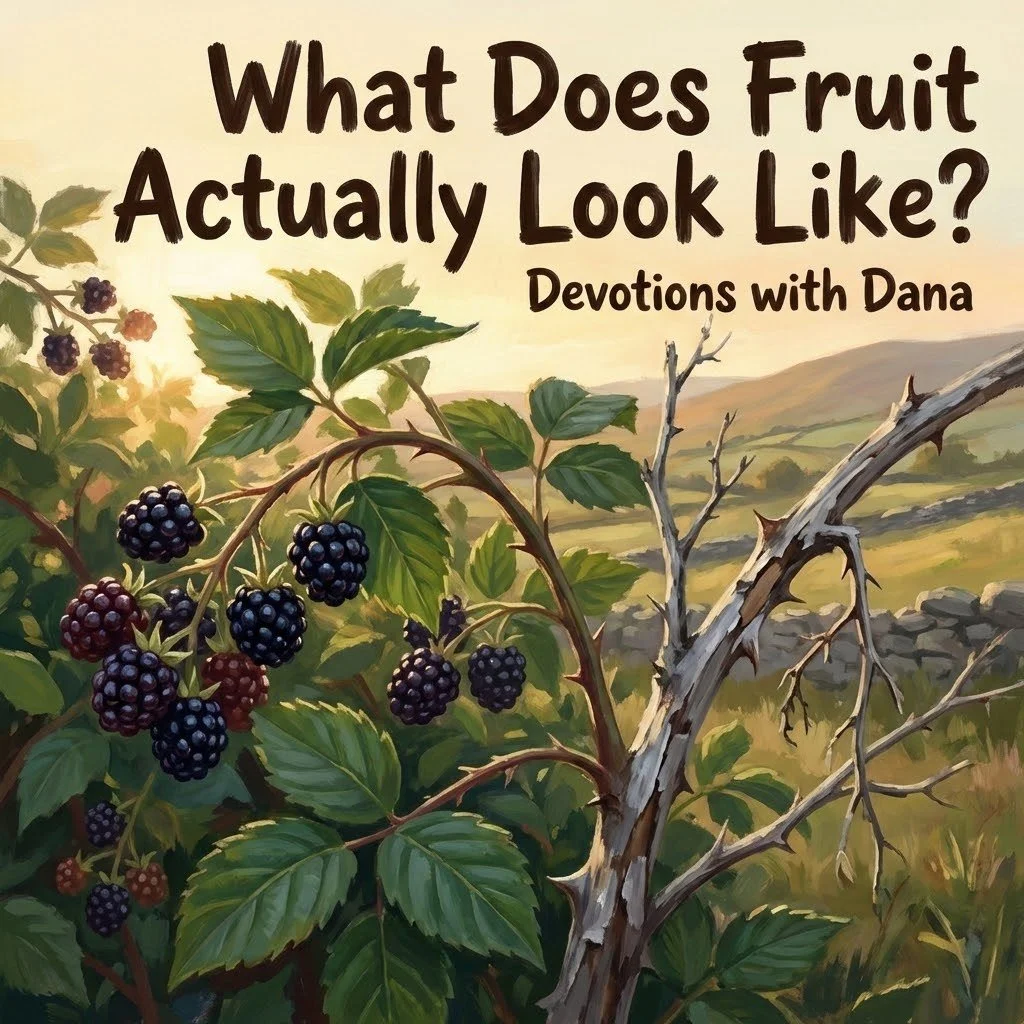
We have blackberry brambles growing along the lane near our house in Wales.
Every summer, I walk past them on my way out to walk the dog, and every summer, I stop and stare. On the very same plant, you'll find two completely different stories. One branch is lush and heavy, bowing under the weight of dark, plump berries — leaves glossy, color deep, life just dripping off it. And right next to it? A brittle, grey, bare little stick. No leaves. No berries. Nothing to show for itself at all. Same plant. Same soil. Same rain. Completely different result.
Now, here's the thing. If you saw only the bare branch, you might not immediately know what you were looking at. Was it a blackberry? A rose? Something else entirely? Without fruit, it's awfully hard to identify the plant.
Jesus had something to say about that. "By their fruits ye shall know them." (Matthew 7:20)
And yet, I think most of us, if asked to define "spiritual fruit," would get a bit fuzzy. We know it's something we're supposed to have. We know it's supposed to be evidence of our faith. But what does it actually look like? Because I'd argue that there's sometimes a yawning gap between looking the part and actually producing something, and learning to tell the difference matters.
Paul tells us in Colossians 1:10 that we ought to be "fruitful in every good work." That's a wide, sweeping statement that covers a lot of territory. So let's take a closer look, because according to Scripture, this fruit comes in three distinct varieties.
First: The Fruit of Character.
This is the inside job, the transformation that happens in the quiet, hidden places of a soul that is genuinely connected to the Vine.
Paul names it plainly in Galatians 5:22-23: "But the fruit of the Spirit is love, joy, peace, longsuffering, gentleness, goodness, faith, meekness, temperance: against such there is no law."
Do you notice what each of those things is? They're qualities. Characteristics. They describe who a person is, not just what a person does. Every single one of them is deeply, stubbornly internal. You cannot buy love at the shops. You can't muscle your way into genuine peace. You certainly can't schedule longsuffering into your diary. (Believe me, I’ve tried!) These things are the life of the Spirit pressing outward from the inside, and they show up first in attitude, in how you respond when someone cuts you off in traffic, in how you treat the cashier who's moving at the speed of a sleepy tortoise, in the quiet of your own home when no one is watching. That's where character fruit grows.
Second: The Fruit of Good Works.
Once the inside is being transformed, it inevitably shows up on the outside. "Being fruitful in every good work" — those are Paul's own words again in Colossians 1:10 — and this is the external harvest. The acts of kindness that cost you something. The service that goes unnoticed. The obedience that nobody applauds. This is faith made visible, love with its sleeves rolled up. Good works that flow from a genuine spiritual life look fundamentally different from those done out of obligation or image management. One is a berry on a living branch. The other is a plastic bunch of grapes from a craft store, convincing at a distance, but hollow up close.
Third: The Fruit of Souls.
This is the eternal harvest, the one that outlasts everything else on earth.
Jesus is beautifully specific about it in John 15:16: "I have chosen you, and ordained you, that ye should go and bring forth fruit, and that your fruit should remain."
That word remain means permanent. Lasting. Fruit that doesn't rot. A life touched by the Gospel through your testimony, a neighbor who came to Christ because of what they saw in you during your hardest year, a child whose faith took root because of your faithful witness. That fruit will still be standing long after the earth itself has passed away.
Here is what strikes me every time I look at those bramble branches. The lush branch isn't doing anything dramatic. It isn't performing for passersby. It isn't announcing itself. It's simply alive, and the evidence of that life is unmistakable. Dark, heavy, beautiful fruit. No labels necessary. You take one look, and you know exactly what kind of plant it is and whether it's connected to the root.
The same should be true of us.
A genuinely fruitful Christian isn't primarily someone who has mastered a long list of spiritual disciplines or earned a reputation for busyness at church. The genuinely fruitful Christian is someone in whom the life of Christ is so real, so present, and so tangible that it shows up in their character, presses outward into their deeds, and spills over into the lives of people around them.
Fruit is not a trophy we display. It is evidence of a life we are living.
"That ye might walk worthy of the Lord unto all pleasing, being fruitful in every good work, and increasing in the knowledge of God." — Colossians 1:10