You Survived the Fire! Let God Take the Smell, Too!
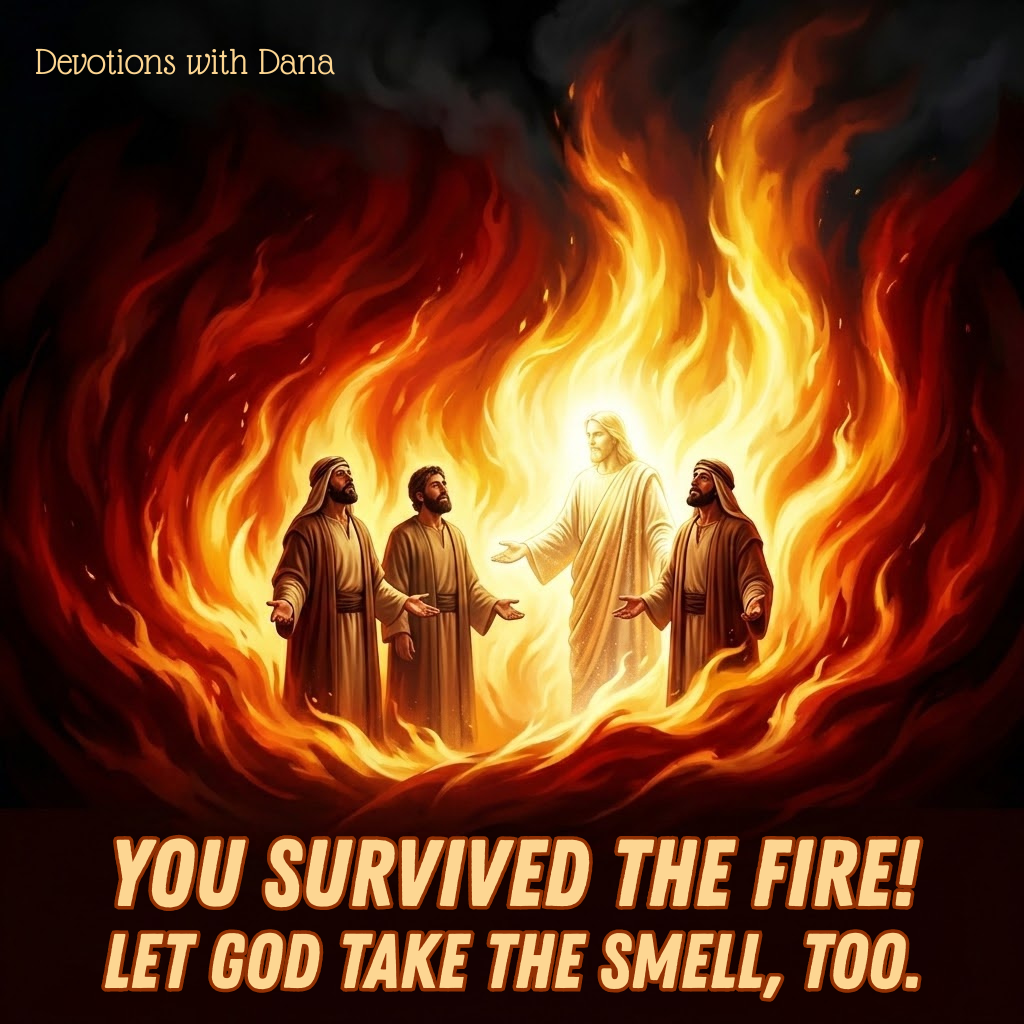
Can I tell you about three men who should have smelled terrible?
Picture it. Babylon, circa 600 B.C. King Nebuchadnezzar has erected a golden image ninety feet tall and commanded every living soul at the ceremony to bow down and worship it. The penalty for non-compliance? A furnace.
Shadrach, Meshach, and Abednego refused to bow.
So, they were hauled before the king and given one last chance to comply. When they politely declined, with what I can only imagine was the most serene look on their faces, they were bound and thrown into that furnace. It was so hot that the soldiers who threw them in were killed just by getting near the opening. The flames swallowed those three faithful men whole.
And then... nothing.
Well, not nothing. Nebuchadnezzar leaped to his feet in a panic. "Did we not cast three men bound into the midst of the fire?" His advisors confirmed it. "Lo, I see four men loose, walking in the midst of the fire, and they have no hurt; and the form of the fourth is like the Son of God." (Daniel 3:25)
The fourth man. Jesus Himself had shown up in the furnace.
And when the three Hebrew children walked out, the Bible records something almost comical in its precision: "...nor was an hair of their head singed, neither were their coats changed, nor the smell of fire had passed on them." (Daniel 3:27)
Not. A. Whiff.
Let that sink in. These men walked through what amounted to an ancient industrial smoke chamber, and they came out smelling like a spring morning. God didn't just protect them from being burned. He created a complete bubble of divine protection so thorough and so exact that even the smell of the fire had no claim on them whatsoever.
And that is the nugget I need to put in your hands today.
You see, we all face fires. Maybe yours is a health crisis that has dragged on so long you've forgotten what "well" felt like. Maybe it's a betrayal so sharp that you still flinch when you remember it. Maybe it's a loss so heavy that grief has moved in and started rearranging the furniture. And here's the thing about fires: even after you're technically out of them, you can still carry the smell.
You might carry the smell of bitterness: "I can't believe they did that to me."
You might carry the smell of "why me?" That sour, gnawing question that poisons everything it touches.
You might carry the smell of trauma, flinching at anything that reminds you of the flames.
I've been there. If you've lived more than twenty minutes on this planet, you probably have too. We come out of the fire technically alive, but still singed. Still reeking of smoke. And everybody around us can tell.
But Daniel 3 paints a breathtaking picture of what God is able to do when we trust Him fully in the fire. He is able to deliver us so completely that when people look at us, they don't see victims who smell like smoke. They see victors who look like they've been walking with the Son of God. Because that is exactly what Shadrach, Meshach, and Abednego were doing. Walking with Him, right there in the heart of the inferno.
Here's the part that really undoes me, though: those three men walked out of the furnace and straight into a promotion. Nebuchadnezzar was so wrecked by what he witnessed that he elevated them to a higher position than they'd held before (Daniel 3:30). The fire didn't just fail to destroy them. It became the launchpad for their next season of blessing and influence.
We are so convinced that our trials will set us back, cost us our position, and ruin our future. But in God's economy, the furnace is often where He does His finest work. He uses it to refine us, to prove us, and often to launch us into places we never could have reached without it.
So don't carry the smell of your fire. Lay it at the feet of the One who has been in furnaces before and knows exactly what He's doing in yours.
"Now thanks be unto God, which always causeth us to triumph in Christ, and maketh manifest the savour of his knowledge by us in every place." — 2 Corinthians 2:14
🔍 PULLING BACK THE CURTAIN: A Peek at the Study Behind This Post
The whole thing started with four words in Daniel 3:27 that most readers skim right past: "nor the smell of fire." Seriously, who notices a negative detail like the absence of a smell in the middle of one of the Bible's most dramatic miracles? But once you see it, you can't un-see it.
Here's how the study unfolded:
The initial observation. Reading Daniel 3 in the KJV, the phrase "nor the smell of fire had passed on them" stopped me cold. The text doesn't just say they weren't burned. It specifies no singeing, no changed clothing, and no smell. That level of specificity in a Bible narrative is almost always a flashing sign that says, "Dig here!”
The rabbit trail: What does fire smell like, and why does it cling? A quick practical search into smoke particles confirmed that smoke residue is notoriously clingy (not that I didn’t already know that from walking in and out of a gas station). It embeds in fabric, hair, and skin at a molecular level. The furnace wasn't a campfire; it was an industrial kiln. The idea that three men walked out of it smelling fresh is not just miraculous; it's scientifically outrageous. That contrast is what sharpened the "bubble of protection" concept.
The cross-reference hunt. Searching the KJV for the word savour (smell/aroma) led straight to 2 Corinthians 2:14 — "maketh manifest the savour of his knowledge by us." The same Greek root (osmē, aroma) appears in connection with triumph in Christ. That connection is not coincidental; it became the anchor verse for the application.
The thematic link to trauma and bitterness. Noting that many believers do carry the "smell" of their fires long after they're out prompted a search on KJV passages about carrying burdens, bitterness (Ephesians 4:31, Hebrews 12:15), and healing. The contrast between what can happen and what God intends became the heart of the application.
The "launchpad" discovery. Re-reading Daniel 3:30 — "Then the king promoted Shadrach, Meshach, and Abednego." That single verse reframes the entire narrative. This wasn't just survival; it was advancement. Cross-referencing with Psalm 66:12 ("thou broughtest us out into a wealthy place") locked in the idea that the furnace was not a setback but a setup.
⏱️ Total study time: About 2 hours, which mostly felt like one long "Wait, WHAT?!" moment after another. The best kind of Bible study. I love these!!!
This is the stuff that gets me genuinely excited about opening my Bible every morning. No matter how familiar the story may seem, every passage has layers, and you don't need a seminary degree to find them.
Your turn: Grab your KJV, pick a verse that makes you pause, and start pulling the thread. You'll be amazed where it leads. The treasure is in there. I'm just handing you the shovel.