Stop Changing the Message, and Start Changing the Method
I've been watching birds from my bedroom window long enough to know the regulars. There's the suet ball crew of sparrows, blue tits, and starlings as loyal as a Tuesday morning prayer meeting. Then there's the odd assortment of birds ranging from pigeons to chaffinches, who show up on the driveway every morning like clockwork when the birdseed hits the pavement. They're sweet. They're faithful. And I enjoy studying them from the sliding glass door of my office.
Recently, Jason hung a new seed feeder out by the clothesline post. It's a little farther from the house, but still in a good enough spot to watch from the kitchen window. For a while, absolutely nothing happened. The birds ignored it so completely that I was starting to feel personally offended. We put the same seed in there! What's the problem?!
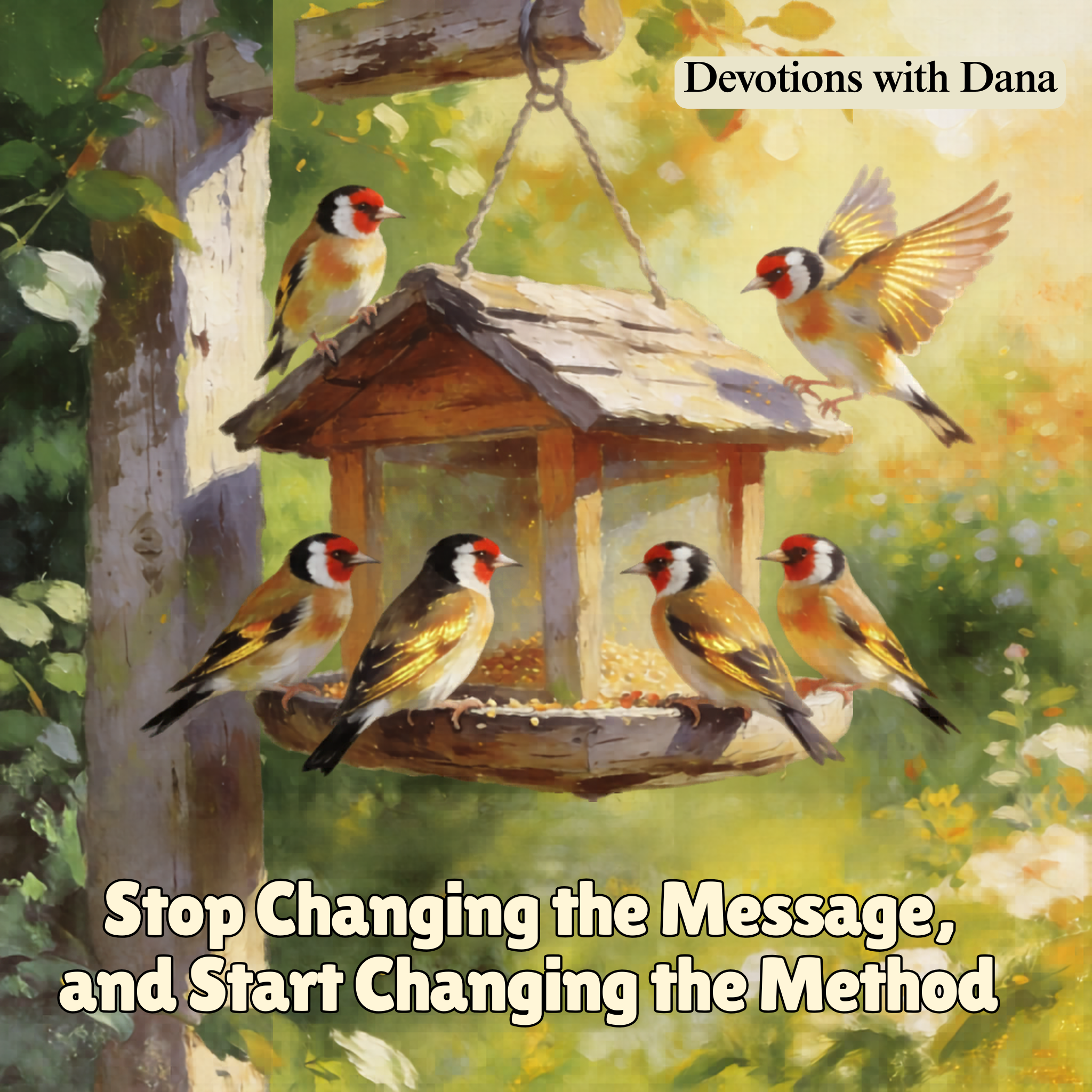
Then, one cautious little bird swooped in to investigate. It pecked around, liked what it found, and apparently went home and wrote a glowing review, because a few days later, a second bird arrived. Then a few more. Yesterday morning, I looked out and counted six of them! Six goldfinches, all gathered together at that one feeder, their red-crowned heads and gold-tipped wings flashing in the morning light like a tiny, flying stained-glass window.
Now, here's what caught my attention: We did not change the seed. Not one bit. Same blend, same brand, same recipe it's always been. What changed was the location. We provided a new spot, a new approach, and suddenly we were attracting birds we'd never seen in our garden before.
The same thing happens in ministry, and far too often, the church gets it backwards. When the pews start to thin out and the younger generation stops showing up, well-meaning leaders sometimes panic and start fiddling with the seed. They water down doctrine. They soften the gospel. They sidestep sin and substitute inspiration for conviction, thinking that if they just make the message more palatable, more people will come. That, friend, is changing the seed. And you should never change the seed.
The problem isn't the seed at all. It might just be the feeder.
The Apostle Paul understood this better than anyone. In 1 Corinthians 9:22, he wrote, "I am made all things to all men, that I might by all means save some." Paul never once altered the gospel message. He preached the same death, burial, and resurrection on Mars Hill that he preached in the synagogue. But he did change his approach. On Mars Hill, he quoted Greek poets to a Greek audience. In the synagogue, he reasoned from the Torah. The seed stayed pure. The feeder moved.
This is the balance that is so desperately needed in ministry today. The gospel is non-negotiable. It is, as Paul says in Romans 1:16, "the power of God unto salvation." You cannot improve upon it, update it, or make it trendier. But the methods? The platforms? The formats, locations, and ways we present it? Those are absolutely up for discussion.
The church that refuses to consider a fresh approach, dismisses every modern avenue of outreach, and clings to tradition for tradition's sake may not actually be protecting the gospel. It may simply be hanging its feeder in a location that certain birds can't find. And the birds you haven't yet attracted? They're not rejecting the seed. They may not even know the seed exists.
But remember what happened after that first goldfinch showed up at our new feeder? It went and told its friends. One became two. Two became six. That's word-of-mouth evangelism in its purest form, and it's been God's plan all along.
"Go ye therefore, and teach all nations." — Matthew 28:19a
The Lord isn't asking us to change what we offer. He's asking us to be creative about where and how we offer it. Keep the seed pure. But pray about where you're hanging the feeder, and watch who comes to eat.
🔍 PULLING BACK THE CURTAIN: A Peek at the Study Behind This Post
It all started when a new bird feeder went up on the clothesline post, and six goldfinches showed up to make a theological point.
The observation that sparked it all. The key insight was simple: same seed, new location, new birds. That's a ministry principle hiding in plain sight. The question became: where does Scripture back this up? Rather than reaching for the obvious "go into all the world" verses, the search went deeper, looking for a biblical figure who modeled method flexibility without doctrinal compromise.
Digging into 1 Corinthians 9. A search of Paul's missionary strategy led straight to 1 Corinthians 9:19–23, where Paul explains his "all things to all men" philosophy in his own words. Key discovery: Paul lists specific groups—Jews, Gentiles, the weak—and describes specific adjustments he made for each. This isn't vague flexibility; it's intentional, audience-aware outreach. Resources used: Blue Letter Bible for cross-references and the Greek word panta ("all things") to confirm the breadth of Paul's statement.
The goldfinch rabbit trail. A quick search into goldfinch behavior turned up a genuinely delightful discovery: a flock of goldfinches is called a charm. That word opened up a whole devotional layer. Imagine what a "charm" of new believers, won one by one, could look like in a local church or community.
Finding the contrast Scripture. To sharpen the "don't change the seed" point, Romans 1:16 was the obvious anchor — "the power of God unto salvation." This kept the application from drifting into "anything goes" territory and grounded the balance: the message is sacred; the method is flexible.
Crystallizing the concept. The devotion came together when the bird illustration and the Pauline principle were placed side-by-side: one brave goldfinch investigates, goes back, and brings six friends. That's exactly how evangelism is supposed to work: reach one, and trust them to reach their people. Matthew 28:19 sealed it as the closing call to action.
⏱ Total study time: About 90 minutes; 20 minutes watching goldfinches from the window (which absolutely counts as research), 40 minutes in Scripture, and 30 minutes connecting the dots. Theology and birdwatching: a surprisingly efficient combination.
Now it's your turn! Pick something you noticed today—something from your kitchen, your garden, your commute—and ask the Lord, "What are You showing me?" Open your Bible, follow the thread, and see where it leads. You don't need a seminary degree. You just need curious eyes and a willing heart. The treasure is already there — go dig!