Is the News Stealing Your Peace?
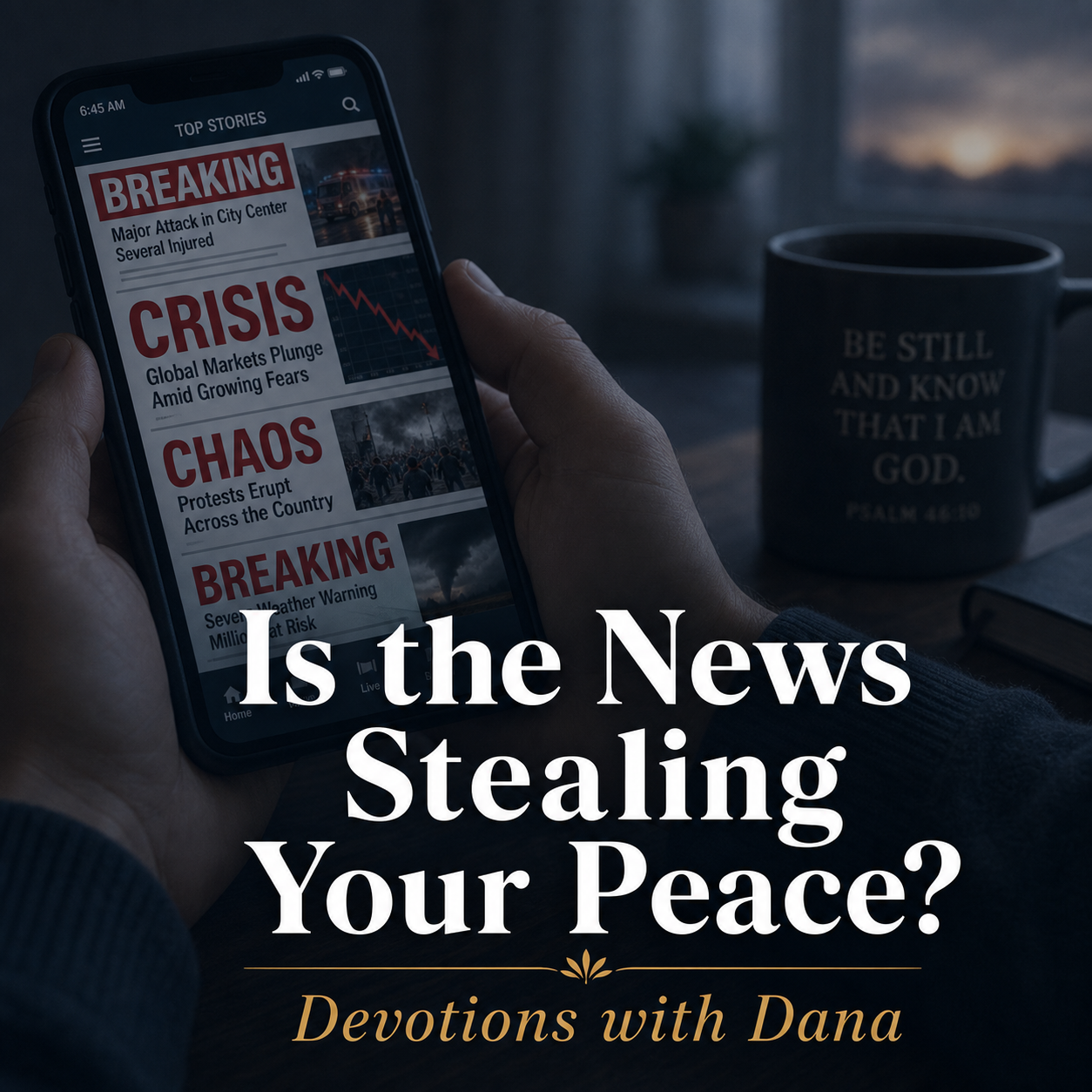
I have a confession to make. I've never been one to watch the news or read the newspaper.
There was simply too much doom and gloom, and I figured anything important would be discussed elsewhere in my circle of friends and family. Even today, you won't find a newspaper, online news thread, or news channel in our home.
Here's the thing about the news: it isn't designed to bring you peace. The media operates on fear.
If it bleeds, it leads.
If it panics, it pays.
And so every broadcast, every headline, every breaking alert is engineered to make you feel like the sky is about to fall because scared people keep watching, and watching people keep the revenue rolling in. The twenty-four-hour news cycle doesn't care about your blood pressure. It doesn't care about your faith. And it certainly doesn't care that you're a child of the Most High God.
But God does.
I think of the prophet Elijah. That man had just witnessed one of the greatest miracles in all of Scripture: fire falling from heaven, the prophets of Baal utterly defeated, the power of God on undeniable display. And then one threatening message from Queen Jezebel sent him running into the wilderness, begging God to let him die. One bad report. That's all it took to send a mighty man of God into a full-blown collapse of faith.
Sound familiar?
The problem wasn't that Elijah lacked faith. The problem was that he'd started listening to the wrong voice. He let Jezebel's message drown out what he'd just seen God do. And that's precisely what the news does to us. It speaks so loudly, so constantly, so dramatically, that we forget or start to doubt what we know to be true about God.
That's why Philippians 4:8 hits differently when you're living in the age of breaking news.
"Finally, brethren, whatsoever things are true, whatsoever things are honest, whatsoever things are just, whatsoever things are pure, whatsoever things are lovely, whatsoever things are of good report; if there be any virtue, and if there be any praise, think on these things."
Paul wrote those words from prison. Not a metaphorical prison. An actual one. With chains. And yet he had the audacity (or rather, the faith) to say: think on these things.
Not on the government.
Not on the chains.
Not on what tomorrow might bring.
But on things that are true and pure and lovely and worth praising. That takes intentional effort. It means making a choice about what we let in.
Now, I'm not saying stick your head in the sand and pretend the world isn't falling apart. It is. Jesus said it would be. "In the world ye shall have tribulation," He told His disciples in John 16:33. But He didn't stop there. He said, "but be of good cheer; I have overcome the world."
He has overcome the world. Already done. It's finished. So every catastrophe the news is screaming about today is operating under the authority of a God who has already won.
Here's what I've found helps most: limit your intake of the world (news and social media), and increase your intake of the Word. That's it. That's the whole strategy. You don't have to quit the news cold turkey. But you can choose not to start your day with it. You can choose to open your Bible before you open your browser. You can choose to spend ten minutes in the Psalms before you spend ten minutes in the headlines.
Isaiah 26:3 promises, "Thou wilt keep him in perfect peace, whose mind is stayed on thee: because he trusteth in thee."
Perfect peace. Not partial peace. Not peace-when-things-are-calm peace. Perfect peace, which is available to any believer who keeps their mind stayed on God.
The news will always have something terrible to report. But God will always have something true to say.
The question is: which voice are you listening to most?
🔍 PULLING BACK THE CURTAIN: A Peek at the Study Behind This Post
This devotion began with observing those who consume news and social media as if it were their daily bread. As a result, their minds are filled with confusion and stress, and their entire lives revolve around fear of the future (and even conspiracy theories). As I meditated on that, the story of Elijah came to mind. The prophet just witnessed fire fall from heaven (arguably the greatest miracle of his ministry) and then crumpled in fear at a woman's threat. That gap between what he knew and how he responded felt very modern and very relatable.
Start with the story. The Elijah narrative in 1 Kings 18–19 is the backbone here. The contrast is striking: verse 38 (fire from heaven) to verse 3 of chapter 19 (running in despair). Reading those two chapters back-to-back highlights the power of a fear-filled message to override what we've just seen God do. That's the hook.
Find the pattern. A word search on "fear not" and "fret not" throughout Scripture reveals how many times God tells His people not to be afraid of exactly what the news throws at us — invading armies, famine, pestilence, geopolitical chaos. The biblical world was never peaceful. Yet God kept saying: be not afraid. That pattern is the backbone of the devotion.
Chase Isaiah 26:3. The word "stayed" in this verse is the Hebrew samak — meaning to lean upon, to rest the full weight on something. It's not a casual glance at God. It's a deliberate, sustained leaning. Strong's Concordance (word #5564) makes the application vivid: you can't lean on God and scroll through fear-mongering headlines at the same time.
Cross-reference with Philippians 4:8 and John 16:33. These three passages form a triangle: what to think on (Philippians 4:8), what to expect (John 16:33a, where tribulation is promised), and why not to fear it (John 16:33b, where Jesus has overcome). Together, they give the devotion its complete argument.
The practical application crystallized. The question "which voice are you listening to most?" came from sitting with the Elijah story and asking: What was his actual sin? It wasn't cowardice. It was a listening problem. He gave Jezebel's voice more weight than God's track record. That's the modern news problem in one sentence.
⏱️ Study time: About two hours, though the rabbit trail through Hebrew words in Isaiah 26:3 added a joyful extra thirty minutes. Some rabbit trails are absolutely worth it.
Want to try this yourself? Take any Bible character who experienced fear and ask: What voice did they listen to, and what was the result? Then ask the same of yourself. The Bible has been diagnosing the human problem of fear-driven living for thousands of years and offering the same cure every single time.