The Poison We Drink
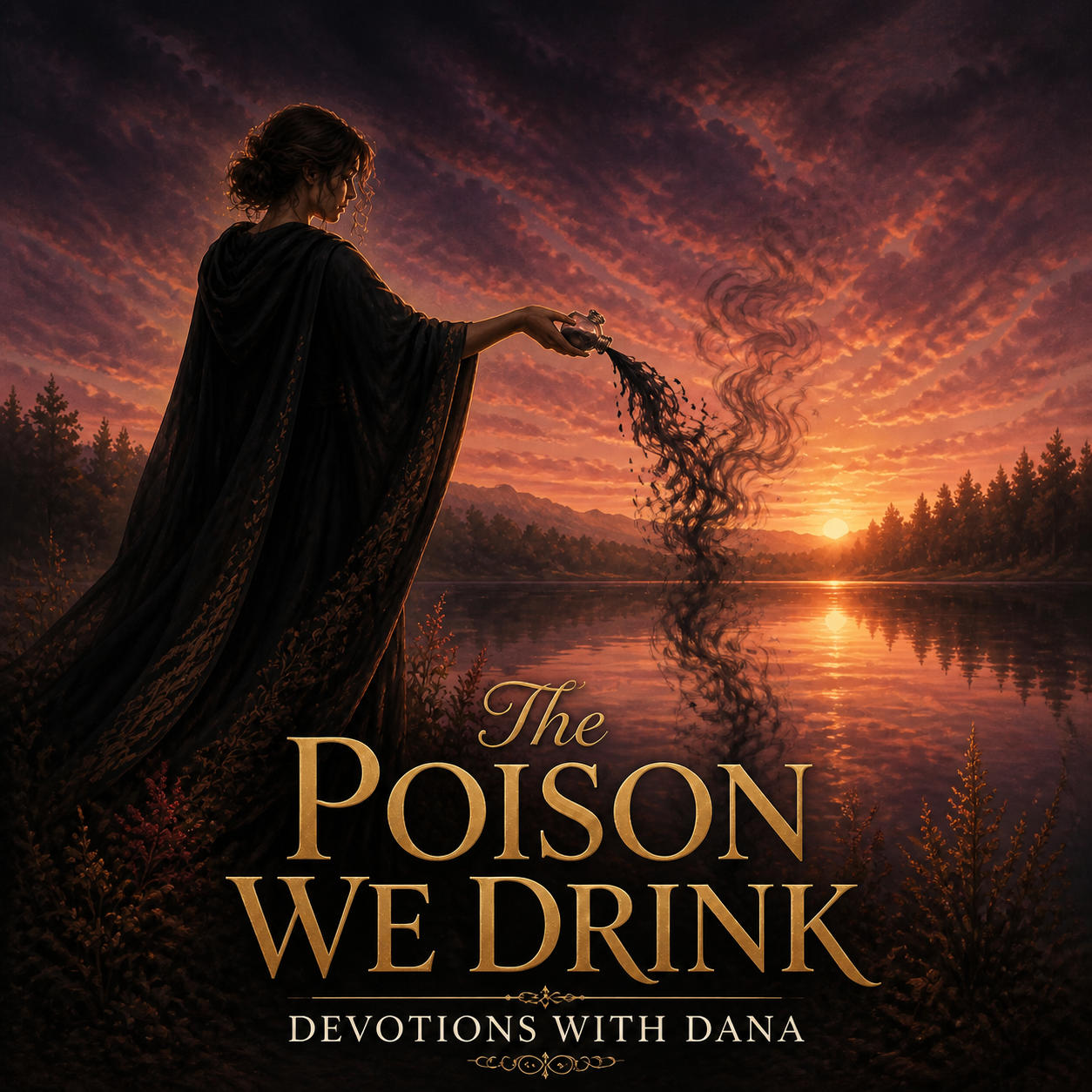
I've been spending a lot of time lately with Merlin.
Now, before you picture a pointy hat and a wand, let me clarify that I'm talking about my Merlin, the protagonist of my upcoming novel, Hope Refined. And this particular Merlin is having a really, really bad day. Actually, make that a really bad season of life.
You see, Merlin has just watched King David, a man he respected and who was supposed to be the model of a great king, sin in a spectacular and devastating way. Betrayal. Corruption. The kind of thing that shakes your faith in people right down to the foundation. And Merlin is furious. Righteously, completely, humanly furious.
And honestly? I get it.
There's something in all of us that ignites when we witness injustice. When someone we trusted lets us down. When the person who was supposed to stand for right chooses wrong instead. That fire you feel? It's not automatically sinful. Anger at injustice can be righteous. Even Jesus flipped tables once.
But here's where it gets tricky.
In the story, Jesus warns Merlin about something that I think we all need to hear: bitterness is simply anger turned inward. It's what happens when righteous fire doesn't have anywhere to go, so it just... sits there. And smolders. And festers. And slowly, quietly, starts burning you from the inside out.
I read a quote once that has never left me: "Bitterness is like drinking poison and waiting for the other person to die." The person who hurt you? They're probably sleeping just fine tonight. Meanwhile, you're lying awake, replaying the wound over and over, giving it room and board in your heart, feeding it three meals a day, and wondering why your soul feels so sick.
That's what bitterness does. It doesn't punish the offender. It destroys the offended.
The writer of Hebrews knew this. In chapter 12, verse 15, he writes, "Looking diligently lest any man fail of the grace of God; lest any root of bitterness springing up trouble you, and thereby many be defiled."
Notice the imagery here of a root. Roots don't stay roots. They grow. They spread underground where you can't see them. And before you know it, what started as a seed of anger has sent its tendrils into every corner of your life, troubling you and everyone around you.

Merlin discovers this the hard way. And if I'm being honest, so have I.
Sadly, we don't conquer bitterness in one dramatic moment of surrender. It doesn't work like that. Bitterness is a daily battle. Every single morning, we have a choice to either feed it or starve it. And the only way to truly starve it is to hand it over to God, not once, but again and again, sometimes hour by hour.
The psalmist David (yes, the same David whose sin inspired Merlin's fury) wrote these words after some of the hardest chapters of his own life: "Trust in him at all times; ye people, pour out your heart before him: God is a refuge for us."(Psalm 62:8)
Notice he doesn't say trust God once. He says trust Him at all times. Because the trust required to battle bitterness isn't a one-time transaction. It's a daily, sometimes moment-by-moment surrender.
Pour it out. All of it. The anger, the hurt, the injustice, the confusion. God is big enough to handle it. He already knows it's there.
You were never meant to carry it anyway.
Every time bitterness rises up, you find yourself rehearsing the offense, hardening your heart, or letting the poison drip, you have to make a deliberate choice to lay it down. Again. Not because the person who hurt you deserves your forgiveness, and not because what happened wasn't wrong. Sometimes it was absolutely wrong. But because youdeserve to be free. Because God has something better for you than a life spent drowning in something that was never meant to be your burden.
Starve the bitterness. Choose trust. One day at a time and, on the hard days, one breath at a time.
The poison was never yours to drink.
🔍 PULLING BACK THE CURTAIN: A Peek at the Study Behind This Post
The spark for this devotion came from a surprising place: a piece of classic character wisdom buried in the phrase "bitterness is anger turned inward." That one line, planted in a fictional dialogue between Jesus and Merlin in Hope Refined, turned out to be a doorway into some of the richest territory in the whole Bible.
Here's how the study unfolded:
Started with the character moment. Merlin's rage at King David's sin felt deeply human and morally legitimate, which raised the real question: when does righteous anger become sinful bitterness? That tension became the devotion's engine. The goal was to validate the anger while charting the dangerous drift into bitterness.
Followed the root. A word search on "bitterness" in the KJV led straight to Hebrews 12:15, and the word "root" was the treasure. A quick dig into the Greek word rhiza (root) confirmed the imagery: something that grows slowly and underground, invisible until its damage surfaces. A good Bible dictionary or Strong's Concordance (Strong's #4491) is perfect for this kind of discovery.
Chased the "poison" metaphor. The famous quote — "Bitterness is like drinking poison and waiting for the other person to die" — is widely attributed (no single confirmed source), but it led to searching for Biblical echoes of the same idea. Proverbs 14:10, Job 7:11, and several Psalms of lament all paint a picture of grief consuming the griever.
Landed on Psalm 62:8. Rather than reaching for the familiar "cast thy burden" verses, a search for trust + pour out + heart in KJV pulled up this gem. The phrase "at all times" transformed it from a one-time act into the daily practice the devotion needed. Cross-referencing with Lamentations 3:25 and Psalm 56:3 reinforced the ongoing nature of that trust.
Connected the dots. The full arc crystallized: righteous anger → festering → bitterness as inward poison → daily surrender → freedom. The fictional Merlin became a mirror for every reader who has ever watched someone they respected fall short and felt the slow burn of disappointment curdle into something darker.
⏱️ Total study time: About two hours, including one rabbit trail into Hebrew lament psalms that didn't make the final cut, but was absolutely fascinating. No regrets.
You can do this exact same process with any truth that stirs you: a quote, a character's struggle, even a conversation that gets under your skin. Start with the feeling, follow it to the Word, dig into the original language (Strong's Concordance is free online!), and then watch a devotion grow right out of the soil. It's less like homework and more like a treasure hunt, and the treasure is always worth finding.

For behind-the-scenes insights, updates on upcoming books, and exclusive content, you are warmly invited to subscribe to my dedicated Renae Edwards’ Substack at https://substack.com/@renaeedwards.