Why the Small Stuff Keeps Stealing Your Joy (and How to Stop It)
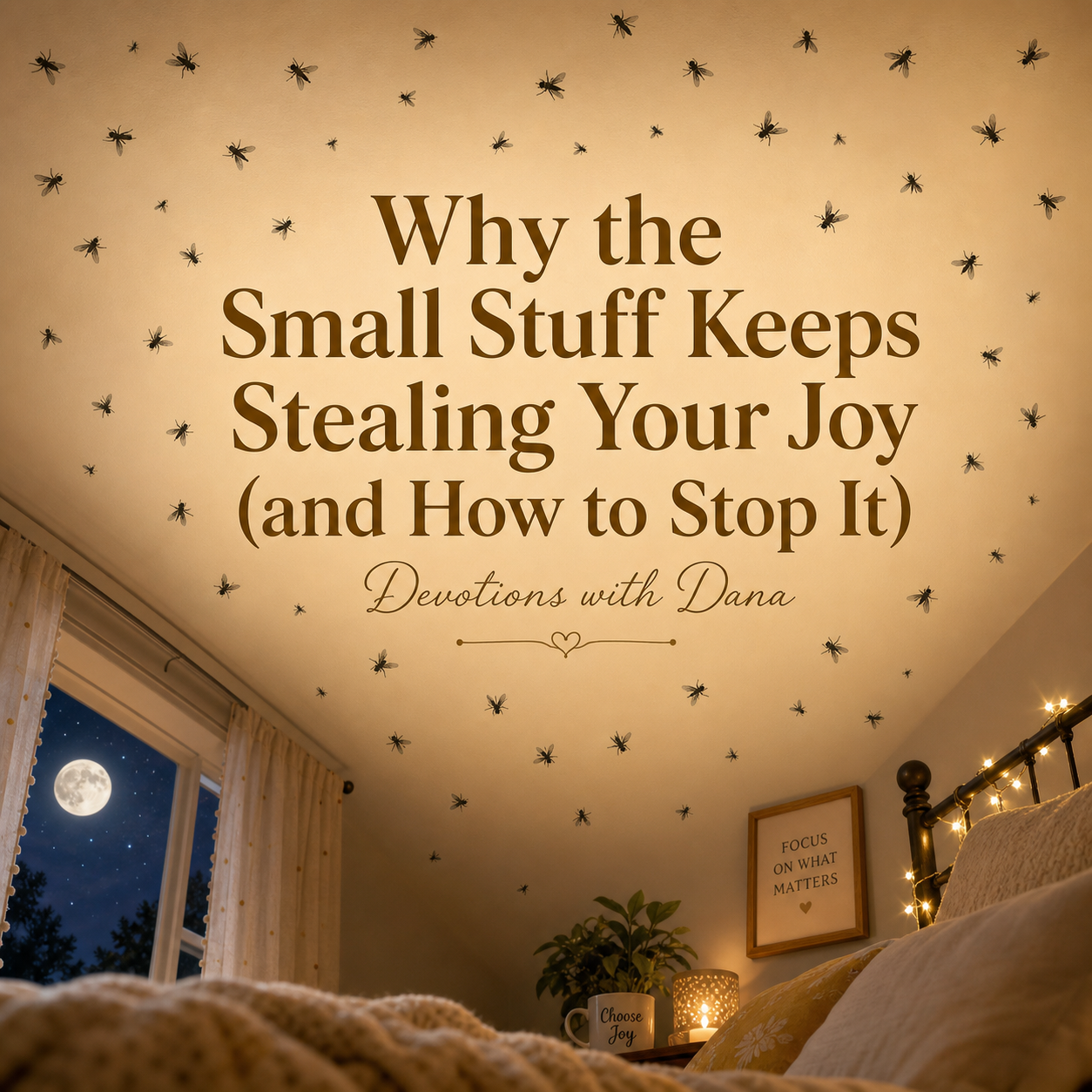
Y'all, I have officially entered my Egyptian plague era. Between the summer heat and the freshly fertilized field behind us, our house has become Fly Central. I'm not talking about the occasional buzzer that sneaks in when someone leaves the door open too long. I'm talking about dozens, maybe more. Scores of flies, staging what I can only assume is an aerial invasion with zero regard for personal space or human dignity.
Last night, as I lay in bed trying to fall asleep, I stared up at my white ceiling, and it looked exactly like the night sky in reverse, with black dots scattered across a pale backdrop instead of white stars twinkling in the dark. Except stars are peaceful. These little dots buzzed, dive-bombed my face, and had the nerve to land on my poor dog Tess while she was just trying to nap. There is no escaping them. None. I've swatted, sprayed, and vacuumed, and still they persist, multiplying like there's no tomorrow.
It's given me a whole new level of sympathy for the Egyptians. When God sent the plague of flies in Exodus 8, "there came a grievous swarm of flies into the house of Pharaoh, and into his servants' houses, and into all the land of Egypt: the land was corrupted by reason of the swarm of flies" (Exodus 8:24). I used to read that verse and think, "Okay, flies, how bad could it really be?"
Friend, I know now. It could be bad.
And my infestation is a mere drop in the bucket compared to theirs.
But here's what got me thinking beyond just my own itchy annoyance. I started wondering why God chose something as small as a fly to humble the most powerful man in Egypt. He could've sent lions. He could've sent fire from heaven. Instead, He sent bugs. Tiny, buzzing, seemingly insignificant bugs that Pharaoh couldn't out-muscle, out-strategize, or out-stubborn his way past.
That's when Ecclesiastes 10:1 landed on my heart in a fresh way: "Dead flies cause the ointment of the apothecary to send forth a stinking savour: so doth a little folly him that is in reputation for wisdom and honour."
Solomon wasn't writing about literal pest control. He was making a point about how something small and seemingly harmless can ruin something valuable if we let it fester. A few dead flies in a jar of expensive perfume don't just add a little smell. They spoil the whole batch!
Isn't that exactly how irritation works in our own hearts? It's rarely the big catastrophes that ruin my joy. It's the small stuff. The rude comment I can't let go of. The chore I resent doing. The minor inconvenience that snowballs into a full-blown pity party because I let it buzz around in my mind instead of swatting it away with truth. One tiny irritation, left unchecked, can spoil an entire day, an entire attitude, and sometimes an entire relationship.
Pharaoh didn't panic because of some grand catastrophe. He crumbled under the weight of gnats and flies he couldn't control.
And I have to ask myself, how often do I let the "flies" of my day (the small frustrations, the minor annoyances, the things too petty to even mention out loud) corrupt my peace the way that swarm corrupted the land of Egypt?
The good news is I'm not left defenseless. Unlike Pharaoh, I don't have to face my swarms alone or in my own strength. Philippians 4:8 tells me to think on what is "true...honest...just...pure...lovely...of good report."
That's not just nice advice. It's spiritual pest control!
When I catch myself dwelling on the small irritations instead of the many good gifts God has given, I need to redirect my thoughts before they spoil the whole batch.
So tonight, when I lay back down and stare at my reverse night sky of buzzing black dots, I'm going to remind myself: the flies are temporary. My peace doesn't have to be corrupted by them. And neither does yours.
Think on these things. Not the flies. The blessings!
🔍 PULLING BACK THE CURTAIN: A Peek at the Study Behind This Post
It all started with a literal swarm of flies buzzing around my house, which sent my brain straight to Exodus 8 and Pharaoh's fly-plagued Egypt. But the real "aha" moment came from a completely different book entirely.
Step 1 – The observation: I couldn't sleep because of the flies buzzing around my face, so I started free-associating: "This is basically my own personal plague." That single thought sent me digging into Exodus 8 to reread the actual plague account.
Step 2 – The cross-reference hunt: While rereading Exodus 8:24 ("the land was corrupted by reason of the swarm of flies"), I got curious whether flies showed up anywhere else in Scripture in a meaningful way, not just as background scenery.
Step 3 – The rabbit trail: A quick concordance search (BlueLetter Bible) for "flies" led me straight to Ecclesiastes 10:1, a verse I hadn't originally planned to use. Reading Solomon's "dead flies... stinking savour" line stopped me in my tracks. It wasn't about literal pest control at all; it was about how small folly ruins something valuable.
Step 4 – Connecting the dots: I sat with the tension between the two passages: one is a massive, dramatic plague (Exodus), and the other is a tiny, almost invisible spoiler (Ecclesiastes). That contrast is what cracked the devotion concept wide open. Pharaoh wasn't undone by something huge. He was undone by something small he couldn't control.
Step 5 – The application click: Once I saw that connection, the whole "small irritations corrupt our peace" angle wrote itself, and Philippians 4:8 (one of my favorite passages in Scripture) came to mind almost immediately as the natural "solution" verse to end on.
Time note: This one took about 40 minutes total, which is honestly impressive, considering half of that time was spent getting distracted while swatting flies away from my face.
If a bug on your ceiling can lead you to a 3,000-year-old verse about spoiled perfume, imagine what you might find the next time something ordinary catches your eye! Grab your Bible, follow the trail of a single word through a concordance, and see where the rabbit hole takes you. You don't need a seminary degree. Just curiosity and a willingness to follow the thread.